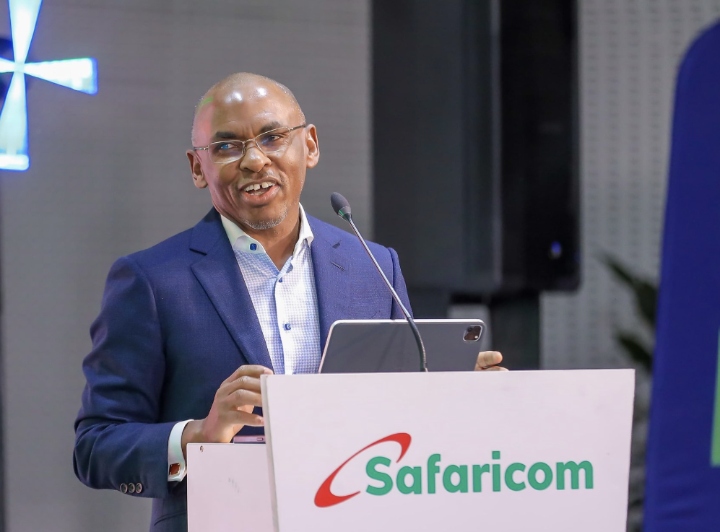
Peter Ndegwa cuts a figure that is deceptively simple in Nairobi’s high-rise hush, where glass reflects ambition and boardrooms hum with quiet power.
No theatrics. No booming declarations. Just a man who walks like he has already solved the problem everyone else is still arguing about.
Ndegwa took the reins of Safaricom on April 1, 2020, an almost mischievous date for a role that tolerates no jokes.
He became the first Kenyan to lead the telecom giant, stepping into the long shadow of Bob Collymore. But Ndegwa did not arrive to echo a legacy.
He arrived to redraw it—quietly and precisely, like a man adjusting the architecture of a building while people are still living inside it.
Quiet operator
His story moves fast, yet never feels rushed.
From the disciplined corridors of Starehe Boys’ Centre and School to the demanding lecture halls of the University of Nairobi, where he studied economics, he sharpened the tools that would later define him: restraint, clarity, and control.
Then came PwC in the early 1990s, where numbers became his first language: cold, exact, and unforgiving.
“I learnt early that discipline beats brilliance when pressure is high,” he once reflected, in that steady, unhurried tone that rarely wastes a word.
But it was Diageo that turned him into something more than a numbers man.
Amsterdam. London. Nairobi. One by one, he climbed: finance director, strategy lead, and managing director.
By 2015, he was running Guinness Nigeria, navigating one of Africa’s toughest markets with the composure of a chess player who never rushes a move.
“Pressure doesn’t disappear,” he has said.
“You just learn how to carry it without letting it carry you.”
Then East Africa. Then broader continental influence. Each role is bigger. Each room is heavier. Each decision was louder—though he never was.
Building a digital nerve centre
And then, Safaricom.
If Collymore was the orchestra conductor, charismatic and visible, Ndegwa is the metronome: steady, relentless, quietly setting the tempo.
Under him, Safaricom has not merely grown; it has morphed. From a telco to a tech nerve centre.
From voice and data to a digital ecosystem where M-Pesa is less a product and more a national bloodstream.
“We are not just connecting people,” he has noted in a past speech.
“We are building the infrastructure of everyday life.”
He discusses “intelligent digital infrastructure” in a manner akin to how an architect describes foundations: invisible, vital, and unavoidable.
And yet, for all the billions, the expansion into Ethiopia, and the tightening grip on East Africa’s digital economy, there is something stubbornly grounded about him.
You see it in the way he listens, head slightly tilted, eyes fixed, as if weighing not just what is said but what is withheld.
You hear it in his voice: calm, almost disarmingly so, even when the stakes are volcanic.
“I protect my time and my energy,” he has shared.
“Because if you are not steady as a leader, nothing else will be.”
There are glimpses, too, of the man beyond the metrics. A private life carefully shielded, save for fleeting public moments—like when his wife’s warm, unguarded praise surfaced after his appointment, offering a rare window into a partnership built away from headlines.

Peter Ndegwa and his wife Jemimah Ndegwa. Photo/courtesy
“Family keeps you grounded,” he has said. “It reminds you who you are when the titles fall away.”
And perhaps that is the enduring paradox of Peter Ndegwa:
In a country that often equates leadership with volume, he has made quietness feel like power.
READ ALSO: Safaricom Explains How to Unmask Mpesa Senders Instantly
Ndegwa holds an MBA from the London Business School and a bachelor’s degree in Economics from the University of Nairobi.
He is also a Certified Public Accountant (CPA) and a member of the Institute of Certified Public Accountants of Kenya (ICPAK).
PAY ATTENTION: Reach us at info@gotta.news.