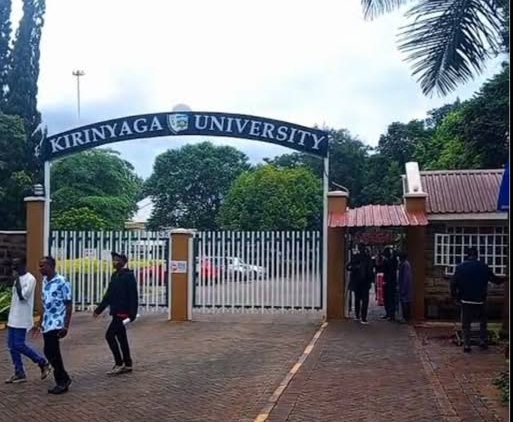
Justice Jacob Gakeri ruled that Kirinyaga University unlawfully excluded lecturers’ union representatives when formulating its workload policy. The court declared the policy invalid, ordered negotiations within 60 days and reinforced workers’ rights to meaningful consultation.
Kirinyaga University has suffered a legal setback after the Employment and Labour Relations Court invalidated its academic workload policy over failure to consult lecturers’ union representatives.
In a judgement delivered on October 22, 2026, Justice Jacob Gakeri quashed the university’s April 2021 Academic Workload and Part-Time Teaching Policy.
The court ordered university management to negotiate workload arrangements with the Kirinyaga University chapter of the Universities Academic Staff Union (UASU).
The negotiations must address workload concerns within 60 days, guided by the Commission for University Education’s standards.
The ruling underscores an important principle: public universities cannot invoke managerial authority to sideline employees’ representatives when determining working conditions.
Union Excluded
The dispute arose after the university introduced its workload policy without involving the recognised staff union.
The union argued that academic workload directly affects employment terms and conditions. It maintained that management should have consulted its representatives before adopting the policy.
The dispute intensified after the university circulated a revised policy to departmental chairpersons on January 28, 2022.
According to the union, academic staff had not been informed or represented during the policy’s formulation.
The union further argued that the university breached a Recognition Agreement signed on October 28, 2019. The agreement provided a framework for negotiations on employment-related matters.
The university rejected the allegations, insisting that the policy merely consolidated existing practices. Management maintained that the policy neither increased teaching hours nor altered lecturers’ contractual obligations.
Justice Gakeri, however, identified a crucial point that both parties accepted.
“It is not in dispute that there exists a policy, subject matter of this dispute, and that the Petitioner was not consulted,” the judge observed.
That admission became central to determining whether the university had acted lawfully.
Workload Dispute
The union alleged that lecturers’ teaching requirements increased progressively without meaningful consultation.
It said the workload rose from three units in 2014 to four units in 2015. The union further alleged that the university subsequently increased the requirement to five units.
Management maintained that lecturers had taught five units weekly since 2018. It argued that staff consultations and existing departmental arrangements supported the workload.
The disagreement escalated in January 2022, when management issued a memorandum requiring additional internal part-time teaching.
The union argued that two additional units would increase the teaching burden to seven units. It challenged that requirement separately, prompting another dispute involving the university.
Management defended its position by citing the prescribed maximum of 40 working hours weekly.
According to the university, lecturers taught 15 hours weekly, leaving 25 hours for preparation, marking, research and administration.
The court recognised the relevance of the Commission for University Education’s guidelines. However, compliance with the 40-hour limit did not excuse failure to consult affected employees’ representatives.
Constitution Prevails
Justice Gakeri relied on Article 232(1)(d) of the Constitution, which requires public institutions to involve people in policymaking.
The court found that Kirinyaga University, as a state corporation, was bound by this constitutional requirement.
It also considered Section 10(5) of the Employment Act, which governs changes to employment particulars.
The provision requires employers to consult employees, revise relevant contractual particulars and notify affected workers in writing.
The judge found that the university’s unilateral approach failed to satisfy the applicable constitutional and statutory requirements.
The court reinforced its reasoning by citing previous workload disputes involving Maseno University and Murang’a University of Technology.
Those decisions emphasised that meaningful consultation must occur during policy formulation. Allowing union representatives to participate only during later approval stages cannot replace earlier engagement.
The court also clarified that consultation does not automatically grant unions veto powers over management decisions.
Instead, affected employees must receive a reasonable opportunity to contribute before decisions affecting their working conditions are finalised.
Policy Quashed
The university also challenged the union’s decision to include the Vice-Chancellor in the proceedings.
Management argued that the officeholder was not a separate legal entity capable of being sued independently.
The court rejected the objection, finding that the union reasonably believed the Vice-Chancellor might have acted independently rather than representing the University Council.
Justice Gakeri emphasised that public university policies require approval from the institution’s authorised policymaking body.
The court also dismissed arguments that the petition duplicated an earlier dispute. The previous proceedings had closed without a substantive determination on the merits.
Having found the petition meritorious, the court declared the workload policy invalid and quashed it.
It directed the university to invite the union for negotiations within 60 days. The parties must maintain the status quo during that period to avoid unnecessary disruption.
Each party was ordered to bear its own legal costs.
The ruling does not establish a new teaching-unit limit or automatically reduce lecturers’ workloads. Instead, it requires management and the union to negotiate a lawful framework.
Its wider significance lies in the limits it places on unilateral policymaking.
READ ALSO: Samson Misango: Kiambu County to Pay Doctor KSh520,588 for Stopping Salary Without Hearing
For academic staff, the judgement strengthens their representatives’ position in discussions over working conditions. For university management, it underscores the legal risks of excluding recognised unions.
Ultimately, the dispute concerned more than the number of classes lecturers should teach. It concerned whether institutions can determine employment conditions without meaningful employee participation.
Justice Gakeri’s decision delivered a clear answer: managerial discretion cannot override the legal obligation to consult.
PAY ATTENTION: Reach us at info@gotta.news.