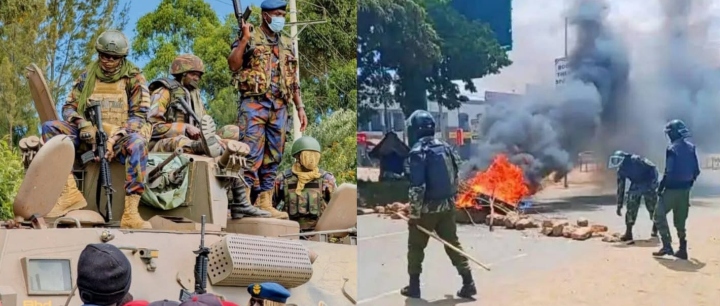
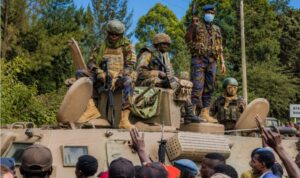
Atop a sand-coloured armoured troop carrier, four soldiers sat like sentinels at the edge of a storm.
Their faces were hidden behind helmets, scarves and tactical masks. M-4 carbines rested across their chests as they surveyed a swelling crowd below.
One officer stood upright above the vehicle’s steel frame, scanning the horizon with the cold vigilance of a man guarding a frontier under threat.
Below him surged a sea of humanity.
Thousands of protesters streamed toward the gates of Laikipia Air Base on Monday, waving Kenyan flags, hoisting placards and chanting slogans that echoed across the roads of Nanyuki.
Bonfires burnt along major routes as black smoke drifted into the crisp highland air. For a moment, the scene felt less like a protest than a standoff between two competing visions of Kenya.
Ebola Quarantine Facility
The demonstrations were sparked by a reported agreement between Kenya and the United States to establish a 50-bed Ebola quarantine and monitoring facility at Laikipia Air Base.
Under the proposal, American citizens exposed to Ebola in Central and East Africa would be flown into Kenya for observation rather than directly to the United States.
READ ALSO: David Miliband Warns Congo Ebola Crisis Could Become Deadliest in History
The plan immediately ignited outrage.
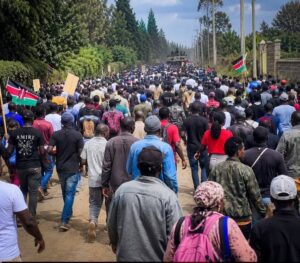
Residents questioned why a country with no confirmed Ebola cases should become a quarantine destination for foreign nationals potentially exposed to one of the world’s deadliest diseases.
“Hell no to an Ebola quarantine facility in Nanyuki.” Let them take it to DR Congo, where it is needed. We’re not going to allow the facility anywhere in Kenya,” one protester declared.
Others pointed to the facility’s proximity to homes, schools and military families, arguing the risks had not been adequately explained to the public.
Bundibugyo Strain
The fears have been amplified by the nature of the outbreak itself. The current Ebola emergency in the Democratic Republic of Congo involves the rare Bundibugyo strain, for which there is currently no approved vaccine or targeted treatment.
Unlike previous outbreaks where vaccines offered a critical line of defence, containment now depends largely on surveillance, isolation and rapid response.
Yet in Nanyuki, the debate has moved beyond medicine and into the realm of politics and sovereignty.
Last week, Justice Patricia Nyaundi issued conservatory orders temporarily halting the establishment or operationalisation of any Ebola quarantine, isolation or treatment facility linked to the reported arrangement. The court also barred the admission into Kenya of persons exposed to or infected with Ebola pending the hearing of a petition filed by rights groups.
Ordinarily, the court order might have cooled tempers. Instead, it intensified them.
Over the weekend, social media platforms buzzed with claims that aircraft linked to the operation had already landed at Laikipia. Reports that a team of American Ebola specialists had arrived only deepened public suspicion.
By Monday morning, frustration had spilt into the streets. Videos and photographs showed vast crowds stretching toward the airbase as police fired tear gas and armoured vehicles blocked key roads.
The symbolism was unmistakable: a government speaking the language of public health was increasingly being met by citizens speaking the language of distrust.
That distrust is rooted in more than Ebola. Kenya’s healthcare system continues to grapple with shortages of medicines, equipment and personnel.
To many residents, the prospect of hosting foreign quarantine operations while local hospitals remain under pressure feels deeply unsettling.
Cooperation Framework
Meanwhile, activists and lawyers have begun probing the origins of the arrangement. Attention has increasingly turned to a broader Kenya-US health cooperation framework signed in 2015.
While no publicly available document explicitly established an Ebola quarantine centre, critics argue successive health-security agreements may have laid the groundwork for the current proposal.
Government officials reject those claims. Health Cabinet Secretary Aden Duale and Medical Services Principal Secretary Dr Ouma Oluga insist Kenya remains Ebola-free and possesses the expertise required to support regional outbreak preparedness.
Washington has also defended the strategy, with US Secretary of State Marco Rubio arguing the move is part of broader efforts to contain the disease.
READ ALSO: U.S. Deploys Ebola Specialists to Kenya Despite Court Freeze on Quarantine Facility Plan
But critics see a government pressing ahead despite mounting opposition and a court order hanging over the process.
Among the most vocal has been lawyer Nelson Havi, who delivered a blistering rebuke as protests intensified.
“It is only in Kenya that we elect representatives to Parliament for the parliamentarians to ask that we the People go to the streets or rallies to demand of the Executive what the parliamentarians should have demanded of the Executive in Parliament. And this, gullible Kenyans, call politics.”
His remarks captured a growing sentiment among critics who believe the controversy is no longer simply about Ebola.
It is about accountability, public trust and the question now echoing from Nanyuki to Nairobi: who gets to decide what risks Kenya should bear?
PAY ATTENTION: Reach us at info@gotta.news