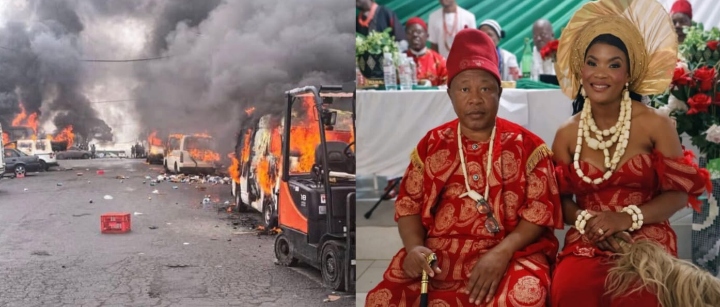
The road into KuGompo East London, no longer feels like an entrance; it feels like a warning. Twisted metal sheets hang off skeletal kiosks.
Shopfronts gape open, gutted and blackened. The ground is carpeted with ash, broken glass crunching underfoot.
Even days later, the air bites, thick with the stubborn smell of smoke and something else: fear.
Residents speak in lowered voices, glancing over their shoulders. “It started suddenly,” one man says, pointing towards a row of burnt stalls.
“By the time we understood, everything was already on fire.”
From coronation to chaos
At the centre of the storm is an extraordinary and controversial moment: the coronation of a Nigerian Igbo man as a local king.
What might have passed elsewhere as symbolic or ceremonial here ignited something raw.
Within hours, the mood shifted. Eyewitnesses describe crowds forming first in clusters, then swelling into mobs.
WATCH | The March & March movement has joined the protest in KuGompo City in the Eastern Cape to protest against the Igbo coronation. pic.twitter.com/Dct28RO6Xm
— SABC News (@SABCNews) March 30, 2026
READ ALSO: Are These the 10 Richest Tribes in Africa?
Chants grew louder. Tempers snapped. Then came the violence and looting of shops mainly owned by foreigners.
Footage circulating widely across social media captures the turning point with unsettling clarity: young men surging through alleyways, some wielding sticks, others iron bars; flames leaping from rooftops; people running, some barefoot, clutching children, bags, anything they could grab.
“It was like the whole place exploded,” a woman recounts, her voice trembling as she stands beside what remains of her shop.
“We just ran. You don’t think – you run.”
The night of fire
As darkness fell, Ku Gompo burnt.
Witnesses say groups moved methodically, targeting businesses and homes believed to be linked, rightly or wrongly, to the controversy.
Doors were forced open. Goods were dragged out. Some looted.
Some were torched. In some streets, entire rows of structures were reduced to smouldering frames within hours.
“I’m pissed off that Nigerians could come here and claim to have a king here.” Prince Xhanti Sigcawu from the Amathole House of Traditional Leaders says the government must deport the people who participated in the coronation of a so-called Nigerian king in the Eastern Cape for… pic.twitter.com/gqihTphV6e
— Newzroom Afrika (@Newzroom405) March 30, 2026
One resident describes hiding in a back room with his family as shouting filled the street outside.
“You could hear everything: glass breaking, people screaming, things collapsing,” he says.
“We thought they would come for us next.”
By dawn, the damage was stark. Smoke curled from the ruins. Livelihoods built over years lay in ashes.
Security arrives
Security forces have since moved in, establishing a visible presence across the town.
Armed officers now stand at key junctions, their patrols frequent but measured. Authorities have condemned the violence in strong terms, calling it criminal and vowing arrests.
Yet on the ground, many residents say the response came too late.
“Where were they when it started?” one trader asks, gesturing toward the remains of his shop.
“Everything was gone before anyone came.”
Officials insist investigations are underway, but for those counting losses, reassurance feels distant.
An anti-illegal migration organization, March and March, along with other groups, brought traffic in KuGompo City South Africa to a complete standstill as they protested the coronation of a Nigerian king. The backlash followed the spread of viral videos and photos on social media… pic.twitter.com/DQoMajDPX6
— Zim-Celebs (@zimcelebs1) March 30, 2026
A deeper fault line exposed
Beyond the destruction, KuGompo is grappling with a deeper rupture.
For some, the coronation challenged long-held beliefs about identity, tradition, and authority.
For others, the anger reflects frustrations that had little to do with ethnicity and everything to do with exclusion, power, and decision-making.
READ ALSO: 6 Tribes with Most Beautiful Women in South Africa
What is clear is that the event became a spark in a place already primed for ignition.
Aftermath
Today, KuGompo moves cautiously.
Children pick through debris, retrieving scraps of what used to be. Traders sit beside shuttered stalls, waiting, watching. Conversations are quiet, often cut short when strangers approach.
The silence is deceptive. It is not peace; it is a pause.
PAY ATTENTION: Reach us at info@gotta.news.