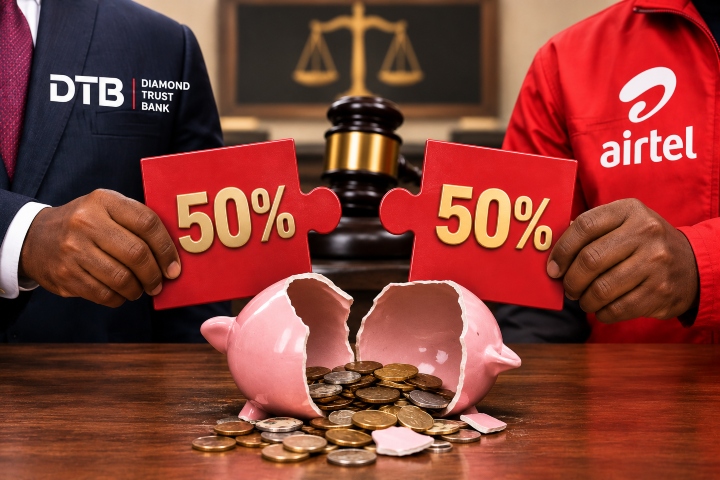
A High Court judge has held Diamond Trust Bank and Airtel partly liable for a mobile banking fraud.
Justice Rhoda Rutto upheld liability after examining how an unauthorised SIM replacement enabled fraudulent withdrawals.
The ruling follows two consolidated appeals arising from a Nairobi magistrate’s judgement delivered in September 2023.
The dispute began after Savraj Singh Chana lost KSh592,864 from his DTB accounts.
The money disappeared between November 12 and November 13, 2018, through mobile banking transactions.
The transactions followed an unauthorised replacement of Chana’s Airtel SIM card.
The High Court found that both companies contributed to the eventual financial loss.
However, it rejected part of the magistrate’s reasoning while preserving the core liability finding.
A Sudden Disconnection
The case began on November 12, 2018, when Chana’s Airtel line unexpectedly stopped working.
He contacted Airtel and was directed towards its offices for assistance.
The following day, DTB contacted him about suspicious mobile banking transactions.
The bank informed him that KSh592,864 had been irregularly withdrawn from his accounts.
The transactions had occurred shortly after his mobile number was compromised.
The earlier proceedings reveal an important detail about what happened next.
Chana sought transaction logs and other information from both companies after discovering the fraud.
Airtel’s response was that some requested information required a court order before disclosure.
Chana subsequently approached the Directorate of Criminal Investigations concerning the disputed transactions.
That history eventually became important when Airtel raised the doctrine of res judicata.
The company argued that Chana had already litigated matters arising from the same transactions.
Justice Rutto rejected that argument because the earlier case sought information rather than compensation.
The earlier constitutional petition had therefore not determined negligence or contractual liability.
The SIM Swap
The High Court found the unauthorised SIM replacement central to the entire fraud.
Airtel’s own witness admitted that the replacement process had been irregular.
The person obtaining the replacement SIM had not been properly identified within Airtel’s system.
That admission significantly weakened Airtel’s attempt to distance itself from the resulting loss.
Airtel argued that it merely provided telecommunications infrastructure to the banking service.
It insisted that DTB controlled the banking PIN and authenticated every disputed transaction.
Justice Rutto accepted that Airtel neither generated nor authenticated Chana’s banking PIN.
But that fact did not erase Airtel’s separate responsibility over SIM replacement procedures.
The judge found that Airtel owed Chana reasonable care when administering his subscriber account.
That duty included properly verifying anyone seeking replacement of his SIM card.
The court also rejected Airtel’s argument that subsequent banking activity broke causation.
The SIM replacement was neither remote nor incidental to the eventual fraud.
Instead, it allowed fraudsters to control the number connected to Chana’s banking facility.
Justice Rutto therefore described the SIM replacement as a substantial cause of the loss.
DTB’s Difficult Defence
DTB faced a different problem, despite proving that its banking system used Chana’s correct PIN.
The bank argued that authenticated transactions demonstrated that its system remained secure.
It also argued that Chana must have disclosed his confidential banking credentials.
The High Court rejected that conclusion because no direct evidence established such disclosure.
The court nevertheless found that DTB had failed to answer crucial questions.
The bank detected unusual activity and attempted contacting Chana during November 13’s early hours.
That evidence demonstrated that DTB had mechanisms for monitoring suspicious transactions.
Yet substantial losses had already occurred before the bank intervened.
More damagingly, DTB failed to produce its own investigation report before court.
The missing material could have explained exactly how the disputed transactions were processed.
It could also have shown when alerts were generated and whether safeguards operated properly.
Instead, those important details remained largely within the bank’s exclusive possession.
Justice Rutto consequently drew an important evidential distinction against the bank.
A customer does not automatically lose protection because fraudsters use correct credentials.
Where crucial system evidence remains exclusively with a bank, explanation becomes particularly important.
The court found DTB had not satisfactorily demonstrated reasonable care under those circumstances.
Chana Was Not Entirely Blameless
The judgement, however, did not place all responsibility on the companies.
Justice Rutto found Chana had also failed to take a reasonable precaution.
He discovered that his mobile line had suddenly become inactive under suspicious circumstances.
Yet he contacted Airtel without immediately alerting DTB about the problem.
That omission gave fraudsters additional opportunity to continue accessing his banking facilities.
The judge therefore upheld the magistrate’s 80:20 liability apportionment.
DTB and Airtel remained jointly responsible for 80 per cent of the loss.
Chana retained responsibility for the remaining 20 per cent because of his omission.
The decision effectively places responsibility across the entire digital banking chain.
A telecom provider must secure SIM replacement procedures against fraudulent identity claims.
A bank must maintain effective monitoring and respond appropriately to suspicious activity.
Customers must also act quickly when their banking-linked communications channels suddenly malfunction.
The ruling therefore stops short of treating fraud as automatically becoming somebody else’s liability.
Instead, responsibility depends upon each participant’s conduct and contribution to the loss.
KSh400,000 Award Removed
The companies achieved an important victory over the additional damages awarded by the magistrate.
The trial court had awarded Chana KSh400,000 for mental torture and stress.
Justice Rutto found that award legally unsustainable under the circumstances of this case.
The judge accepted that losing wedding savings understandably caused Chana distress.
But emotional distress alone did not create entitlement to contractual general damages.
The court stressed that contractual damages ordinarily compensate measurable financial loss.
No recognised exception permitting damages for mental anguish had been established here.
There was also no medical or independent evidence demonstrating recognisable psychological injury.
The KSh592,864 principal loss, however, remained fully established through banking records.
After Chana’s 20 per cent contribution, the recoverable amount became KSh474,291.20.
DTB and Airtel were each ordered to pay KSh237,145.60.
The amount would also attract interest according to the magistrate’s original order.
The High Court ultimately partially allowed both appeals rather than overturning liability entirely.
Each party was ordered to bear its own costs of the appeals.
Justice Rutto delivered the judgement last week.
For Kenyan digital banking users, the ruling carries a broader warning.
A compromised phone number can become the first link in a devastating financial chain.
READ ALSO: ‘Too Late’: Family Bank Loses Court Battle Over KSh720,000 Stolen From Customer’s Account
But the judgement also makes another point equally clear.
Security responsibility does not end with the customer entering a correct PIN.
Banks and telecom companies must demonstrate that their protective systems actually work when fraud emerges.
And customers must respond quickly when their trusted authentication channels suddenly stop functioning.
PAY ATTENTION: Reach us at info@gotta.news.