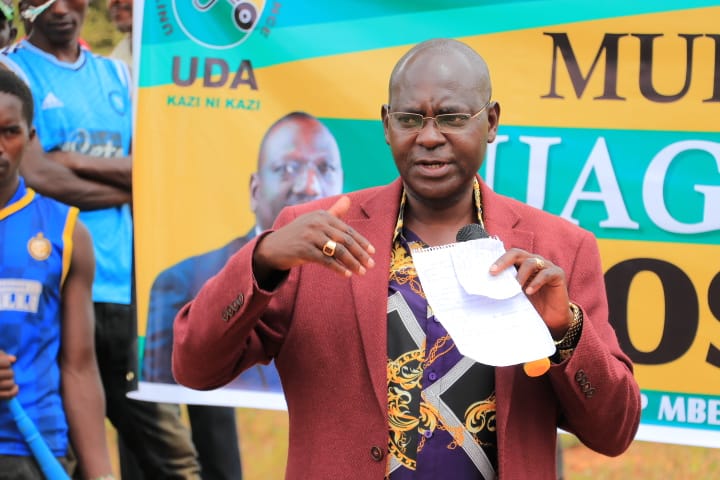
Former Mbeere North MP Muriuki Njagagua is facing a fresh legal battle over a KSh204.6 million claim by SBM Bank Kenya.
The dispute stems from property titles the bank released to Njagagua as the borrowers’ advocate.
SBM alleges the titles were later released to borrowers without its consent.
The borrowers subsequently disposed of properties that had secured their bank facilities.
Now, years later, the High Court has refused to let Njagagua end the case prematurely.
Justice Rhoda Rutto struck out his preliminary objection challenging SBM’s claim as time-barred.
She also allowed SBM to introduce a contested 2022 settlement letter into evidence.
The ruling does not make Njagagua liable for the KSh204.6 million.
Instead, it keeps the bank’s claim alive for determination through further proceedings.
Lost Titles
SBM released the original titles to Njagagua for intended property transactions.
He was acting as advocate for the borrowers during those transactions.
The releases followed undertakings dated April 21 and August 12, 2010.
Under those undertakings, the titles were supposed to return after completion.
The bank later alleged that Njagagua failed to honour those professional commitments.
Instead, SBM said, he released the titles to borrowers without its consent.
The borrowers subsequently disposed of the charged properties, according to the bank.
That alleged conduct eventually triggered disciplinary proceedings against Njagagua.
The Advocates Disciplinary Tribunal eventually delivered its judgement on November 16, 2020.
It found Njagagua guilty of breaching professional undertakings and disgraceful professional conduct.
That finding later became central to SBM’s attempt to recover its alleged losses.
The bank says the parties subsequently entered discussions aimed at resolving the dispute.
Those negotiations, SBM maintains, continued for several years after the Tribunal ruling.
The bank says the discussions continued until sometime in 2024.
Then came the document now sitting at the heart of the dispute.
It was a letter dated October 27, 2022, marked “Without Prejudice”.
SBM says the letter provided important evidence of continuing settlement discussions.
More significantly, the bank argued that it showed acknowledgement of indebtedness.
KSh20 Million Offer
The letter proposed paying KSh20 million towards part of the disputed obligation.
It proposed spreading that payment across 15 years through additional property security.
The proposed security involved two properties located in Dagoretti Mutuini.
Njagagua rejected SBM’s interpretation of the letter and its legal significance.
He maintained that it was simply an unaccepted proposal made during negotiations.
He argued that its “without prejudice” label protected its contents from disclosure.
He also denied that the proposal amounted to any admission of liability.
SBM took a different view of the correspondence and its potential consequences.
The bank argued that an acknowledgement could affect the statutory limitation period.
That argument became particularly important because Njagagua challenged the claim’s timing.
Justice Rutto acknowledged the strong protection surrounding genuine settlement communications.
She noted that the rule encourages parties to negotiate openly without fearing future litigation.
However, she stressed that “without prejudice” protection is not necessarily absolute.
The judge relied on a 2024 Court of Appeal decision involving Heineken and Maxam.
That decision recognised limited circumstances where settlement communications become legally relevant.
In this case, Justice Rutto found the disputed letter capable of competing interpretations.
It could represent an ordinary attempt to compromise a disputed financial claim.
Alternatively, its language could suggest acknowledgement of an existing financial obligation.
Clock Challenge
That distinction became critical because Njagagua attacked the claim as time-barred.
He argued that the alleged professional breach occurred around 2013.
Under the Limitation of Actions Act, contractual claims generally face six-year limitation periods.
He therefore argued that SBM’s July 2025 lawsuit came years too late.
His chronology appeared straightforward: breach, disciplinary proceedings, delay, then litigation.
SBM, however, presented a different timeline and legal interpretation of events.
The bank argued that its claim crystallised after the Tribunal’s 2020 determination.
It also relied upon subsequent negotiations and the alleged acknowledgement of indebtedness.
Justice Rutto refused to settle that disagreement through a preliminary objection.
She found the limitation question depended upon disputed facts and contested correspondence.
The court would need evidence before determining what those communications legally meant.
That approach follows the established principle from Mukisa Biscuit Manufacturing Company.
A preliminary objection should address a pure legal point without disputed factual investigations.
Here, the judge found that limitation required precisely such an evidentiary examination.
The preliminary objection therefore could not provide Njagagua with an early exit.
Instead, SBM was allowed to place the disputed letter before the court.
The bank can also introduce additional documents and another witness statement.
Battle Continues
The ruling also defeated a separate challenge concerning SBM’s supporting affidavit.
Njagagua argued that Beline Ochiel lacked demonstrated authority to swear the affidavit.
He complained that SBM had not exhibited a board resolution authorising her actions.
Justice Rutto found no evidence showing that Ochiel lacked authority from SBM.
She therefore rejected the argument that the missing resolution invalidated the application.
The judge emphasised substantive justice rather than procedural technicalities in reaching that conclusion.
The court consequently allowed SBM’s application dated November 25, 2025.
The bank was given fourteen days to file its additional evidence.
Njagagua’s September 12, 2025, preliminary objection was struck out.
The court also awarded SBM costs for both applications before the court.
Yet the ruling stops well short of awarding SBM the disputed KSh204.6 million.
Justice Rutto expressly left the substantive questions open for later determination.
The court has not finally ruled that Njagagua admitted liability to SBM.
Nor has it been found that the KSh20 million proposal created a binding settlement.
For SBM, however, the immediate outcome represents a significant procedural victory.
Its KSh204.6 million claim remains alive despite the limitation challenge.
The disputed correspondence will now form part of the evidentiary record.
READ ALSO: Court Freezes Magoha’s KSh25M Kileleshwa Apartments Ahead of KCB’s KSh143M Auction
The next phase will determine whether those documents can ultimately save SBM’s claim.
For Njagagua, the preliminary route to ending the case has now closed.
The deeper dispute must instead confront the evidence surrounding the disputed undertakings.
It must also answer whether subsequent negotiations legally affected the limitation clock.
Those questions now await determination through the fuller judicial process.
PAY ATTENTION: Reach us at info@gotta.news.