There is a particular rhythm to Larry Madowo’s life: quick, shifting, almost percussive.
It swings between the polished cadence of global television and the loose, mischievous spontaneity of a Nairobi timeline at 2 a.m.
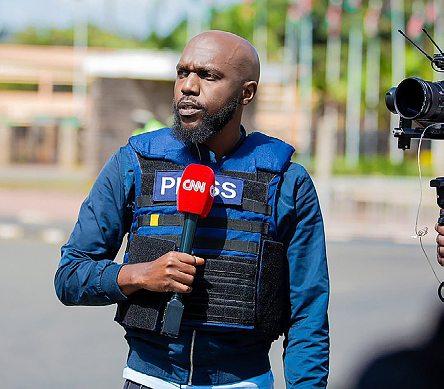
One moment, he stands beneath the bright, exacting lights of CNN, voice steady, framing Africa for the world; the next, he is on his phone, firing off a cheeky “Sasa mko aje?” collapsing continents into a single, intimate exchange.
It is not a contradiction. It is choreography.
From grit to velocity
Born in Siaya in 1987 and raised between Kisumu and Nairobi, Madowo’s early life reads like a study in endurance.
Loss came early; responsibility came sooner. Orphaned before adulthood, he learnt to move quickly, instinctively, through spaces that offered little certainty.
There are stories of him selling tea and mandazi in Gikomba, of knocking on newsroom doors, of absorbing rejection without surrender.
“I didn’t have the luxury of waiting for things to line up,” Madowo has said in interviews.
“I just kept moving.”
That movement found direction inside Kenya’s media ecosystem. At NTV Kenya, he did not simply deliver the news; he bent it into something more kinetic, more conversational.
On #TheTrend, a show that felt less like a broadcast and more like a live wire, he curated a generation’s conversation tweet by tweet, meme by meme.
The studio pulsed with neon light; screens flickered with hashtags; and Madowo, sharp, quick, and faintly irreverent, stood at the centre, both conductor and participant.
He understood something many missed: that news was no longer a monologue. It was a conversation. And he intended to be fluent in it.
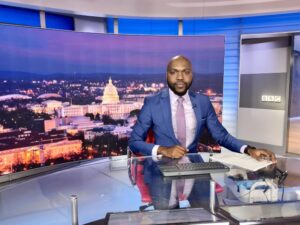
Larry Madowo. Photo/courtesy
Global stage, local pulse
To scroll through Madowo’s social media is to step into a restless, vivid mosaic. A selfie in Lagos, sunlight catching the edges of his grin.
A tightly argued thread on governance, crisp and unsparing, that critiques current policies and suggests innovative solutions for improving public administration.
A dispatch from Davos or Doha, punctuated by a casual aside in Sheng.
He moves between English, Swahili, and street slang with the ease of someone who does not translate himself for comfort.
“I am very Kenyan,” he once wrote.
“That doesn’t switch off because I’m on international TV.”
At first glance, the feed feels almost random. But linger, and a pattern sharpens into view.
One moment, he is breaking down vaccine inequity for a global audience; the next, he is joking about matatu culture or Arsenal’s latest stumble.
It is not carelessness; it is design. He refuses to conform to a single tone. A reminder that credibility need not come at the expense of personality.
This instinct, to remain rooted while moving globally, is what sets him apart.
Where others adopt a neutral, placeless cadence, Madowo leans into identity.
He code-switches without apology, carrying Nairobi into every studio he enters. His voice does not dilute; it expands.
His career arc reflects that same restless momentum. From a trainee at KTN to anchoring on CNBC Africa, back to NTV, then onwards to BBC News as Africa Business Editor and later North America correspondent—before arriving at CNN.
On paper, it reads like a clean ascent. In practice, it is a series of sharp pivots, each requiring reinvention without erasure.
“You don’t leave where you come from,” he has said. “You carry it with you.”
His reporting spans elections thick with tension, pandemics that redrew global fault lines, protests that pulsed with urgency, and high-level summits where decisions ripple across continents.
Yet even in the most high-stakes moments, there is an ease about him, a steadiness that suggests he is not performing authority but inhabiting it.
And still, there is that looseness. He calls himself a “nomad” and a “jokester”, and the words feel less like branding than confession.
READ ALSO: Peter Ndegwa: The Unflashy Genius Rewiring Safaricom Without Raising His Voice
His Instagram grid is not a curated monument but a living, breathing archive: newsroom, airport lounge, and roadside café, all stitched together by motion.
He resists becoming fixed, preferring instead to remain in transit—physically, intellectually, and culturally.
PAY ATTENTION: Reach us at info@gotta.news.