They say that even the darkest story carries a sliver of laughter tucked somewhere in its ribs.
And if that proverb ever needed a living, staggering, red-eyed illustration, then Mombasa’s mateja have volunteered themselves; unpaid, unbothered, and occasionally unconscious.
Welcome to their theatre.
From Mwembe Tayari to Kisauni, from Bamburi to the philosophical pavements of Mtwapa, mateja roam like wobbly emperors of a crumbling kingdom.
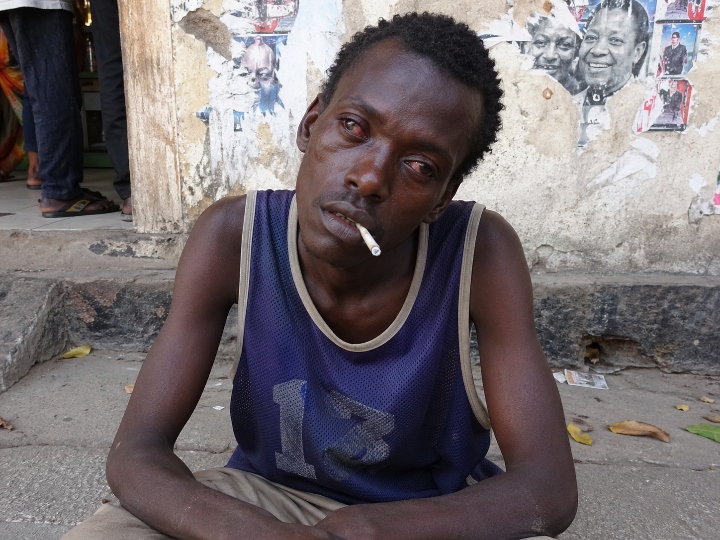
You’ll spot them easily: oversized basketball vests that have seen more seasons than a baobab tree, shorts hanging on for dear life, and eyes so red they look like they’ve been arguing with onions.
They don’t walk so much as negotiate gravity. In fact, when a teja approaches you, you meet his knees first; his upper body arrives later, like an afterthought.
Their office? The matatu stage. Their profession? Manamba fills matatus for a living, one passenger at a time, for a princely sum of twenty or forty shillings.
Enough, apparently, to fund a return ticket to another dimension via kuber, bugizi, bhang, or whatever concoction is trending in the maskan that week.
But here’s the thing: Mateja are not just addicts. They are philosophers, linguists, and part-time comedians sponsored by chaos.
Take their language. A drizzle begins, and while ordinary wananchi reach for jackets, a teja announces with great urgency, “Mwanangu, acha nikadunge weather!”
To him, weather and jacket are interchangeable. Why? Because, in his universe, cause and solution are roommates.
Try arguing with that logic; you’ll be promoted instantly to kozmeni (peeper/spy), and your friendship will be terminated without notice.
And their confidence? Untouchable.
You may find a teja broken, barefoot, and borrowing oxygen, but he will still promise you a lift in the Mercedes he is about to acquire.
How? Details are for sober people. Maybe he’ll marry into a presidential family. Maybe he’ll find a mysterious bag of money abandoned by another teja who temporarily forgot he was a millionaire.
Either way, when the riches come, you, yes you, will ride. Provided you didn’t disrespect him earlier.
Broke today, billionaire tomorrow.
Respect is key in this economy of illusions.
Spend five minutes with a teja, and he will trust you with secrets people reserve for priests and Wi-Fi passwords.
One will casually narrate how he earned his facial scars while “shopping” for handbags on Digo Road.
Another will lecture you passionately on the origin of reggae music, only to pause mid-sentence and ask, “Nilikuwa nasema nini?”
Even their warnings come dressed as jokes.
High as satellites, they’ll turn to school kids and declare, “Someni, msikuje huku.” Study hard; don’t end up like us.
Then, moments later, when you advise them to quit drugs, they will fire back with devastating logic:
“Wewe hutumii dawa, lakini uko na ndege?”
You don’t use drugs, but do you own a plane? Mind your business, professor.
Meanwhile, society laughs. Children have turned them into punchlines. Entire walls near maskans are decorated with slogans like “Jobless Millionaire Corner” and ambitious adverts from painters offering to repaint the sky—clearly tired of its current management.
Yet beneath the humour lies a slow-burning tragedy. Families fractured. Potential buried. Youths who once ran races now run errands for hallucinations.
READ ALSO: Gaucho’s Mama Lucy Board Appointment Sends Kenya Into Full Comedy Emergency
Still, the Mateja insist on their final word: don’t pity them. Today is dust; tomorrow is destiny.
And when that destiny arrives, preferably with a V8 engine, you’d better have been kind.
Because in their world, even ruin deserves a good laugh.
PAY ATTENTION: Reach us at info@gotta.news.