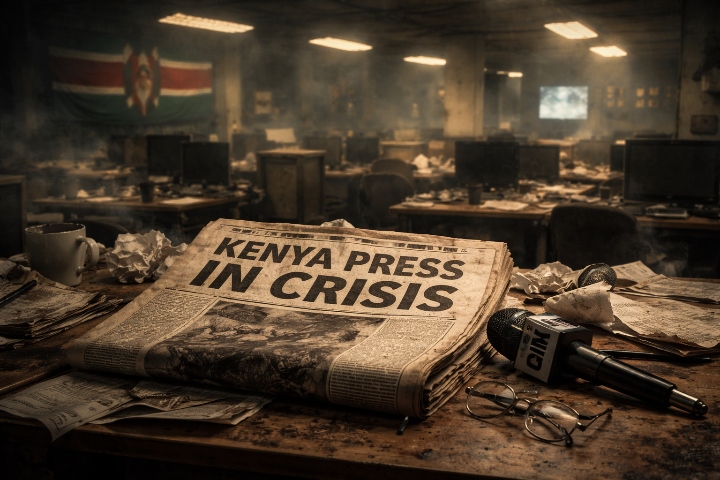
Editor’s Note: In this incisive commentary, former legacy media journalist MM examines the slow but unmistakable decline of Kenya’s once-dominant news institutions.
Drawing from newsroom experience and the shifting realities of the digital age, he unpacks the forces—both external and self-inflicted—that are hollowing out the country’s mainstream media.
He contends that although the decline of the industry may seem unavoidable, the implications could be significantly more alarming for the state of democracy in Kenya.
For decades, Kenya’s legacy media stood like a lighthouse on the country’s democratic shoreline. Newspapers set the national agenda. Editors wielded enormous influence. Governments feared the morning headlines. Politicians scrambled to control the narrative.
Today, that lighthouse flickers.
Across Kenya, once-dominant media houses are shrinking. Newsrooms are thinning. Revenues are collapsing. Layoffs arrive in waves.
Meanwhile, social media platforms – characterised by their chaos, lack of regulation, and rapid pace – have emerged as the new marketplace for capturing public attention.
The decline of Kenya’s legacy media is no longer theoretical. It is happening in real time.
While some may celebrate the decline of legacy media, it is crucial to reflect on the implications. The demise of such institutions seldom bodes well for the health of a democracy.
Yet the uncomfortable truth must be stated plainly: part of the crisis has been self-inflicted.
The advertising gold rush that blinded the industry
In the early 2000s and well into the 2010s, Kenya’s mainstream media was extraordinarily profitable.
Full-page newspaper advertisements could cost up to KSh 1 million. Radio and television advertising slots were booked weeks in advance.
Corporate brands competed for visibility. Government ministries spent heavily on public notices.
At their peak, the country’s largest media houses generated billions of shillings annually.
Newsrooms held significant influence as powerful institutions. Editors played a critical role in shaping political discourse, with a front-page story possessing the potential to destabilise a cabinet secretary or initiate a national investigation.
But prosperity bred complacency.
By 2015, the tectonic plates of global media had already begun shifting.
Facebook, YouTube and X (formerly Twitter) were capturing audiences. Influencers were emerging as alternative advertising vehicles. Globally, digital advertising was migrating toward tech platforms.
According to PwC’s Global Entertainment & Media Outlook, by the late 2010s Google and Meta were absorbing more than half of global digital advertising revenue.
The signals were clear.
Yet many Kenyan media executives refused to see them.
The fatal underestimation of the internet
Inside many newsrooms, the internet was treated as an afterthought.
Websites existed, but largely as dumping grounds for stories already printed in newspapers. The digital audience – often younger, more impatient, and globally connected – was not taken seriously.
In editorial meetings, blogs were dismissed as gossip.
Social media? A passing fad.
Many editors, seasoned veterans in their late forties and fifties, viewed the digital shift with quiet scepticism. Print has worked for decades. Why should it suddenly collapse?
The mistake was catastrophic.
Globally, newspapers that survived the digital revolution did one thing early: they invested heavily in digital journalism.
The New York Times, for example, pivoted aggressively toward subscription-driven digital reporting. Today it has over 10 million paying subscribers worldwide – one of the most successful transformations in modern journalism.
Kenyan media houses, by contrast, largely waited.
And waiting, in the digital age, is often fatal.
The culture inside the newsroom
Technology alone does not explain the crisis.
Culture does.
In many Kenyan media houses, hierarchy was rigid, and ideas from younger journalists often died before reaching senior management.
Innovation struggled to breathe in rooms dominated by tradition.
Emails proposing new editorial strategies gathered dust. Suggestions for premium storytelling desks or digital experimentation rarely moved beyond immediate supervisors.
Meanwhile, newsroom politics flourished.
Patronage networks shaped hiring decisions. Nepotism sometimes trumped merit. In certain corners of the industry, appearance mattered more than intellectual depth.
This may sound harsh. But numerous journalists privately acknowledge it.
When recruitment prioritises loyalty over talent, the long-term consequences become inevitable: weaker reporting, thinner analysis, and declining reader trust.
Journalism, at its best, is an intellectual craft. It requires curiosity, scepticism, analytical depth and narrative skill.
Without those ingredients, the product deteriorates.
The paywall problem
As revenues declined, Kenyan media houses eventually turned to paywalls.
The logic was sound.
Globally, subscriptions have become the lifeline of serious journalism. The Financial Times, The Wall Street Journal and The New York Times have all demonstrated that readers will pay for quality reporting.
But execution matters.
Many Kenyan paywalls arrived as hurried, defensive measures rather than carefully designed strategies.
Too often, what sits behind the paywall is thin content: 350-word news briefs, recycled press statements, or stories widely available elsewhere online.
Readers quickly notice this.
Subscription journalism thrives only when it provides depth, which includes investigative reporting, original analysis, long-form storytelling, and expertise that is not easily replicated.
In other words, content that feels worth paying for.
Without that depth, paywalls feel less like a value proposition and more like a toll booth on an empty road.
The cost of serious journalism
Producing truly premium journalism is expensive.
Investigative reporting can take months. Fact-checking requires staff. Skilled editors command high salaries. Data journalism demands technical expertise.
Many Kenyan media executives hesitate at these costs.
Their hesitation is understandable. The industry was built on a model where profits flowed with relatively modest investment.
But digital journalism operates under a different equation.
Quality is not optional. It is the business model.
Without it, subscriptions stall and credibility erodes.
Why Kenyans should care
Despite its flaws, Kenya’s legacy media have historically played a critical role in safeguarding democracy.
Since independence, newspapers and broadcast outlets have exposed corruption, challenged state power and amplified public grievances.
Investigations by Kenyan journalists have revealed procurement scandals, land grabs and misuse of public funds.
These stories often come at great personal risk.
During the authoritarian years of President Daniel arap Moi’s rule, journalists faced harassment, detention and censorship. Yet the press persisted.
The media became known as the Fourth Estate – an informal but vital pillar of democratic accountability.
Without it, the balance of power shifts dangerously.
The rising risk of a “Lootocracy”
Kenya already struggles with systemic corruption. Public scandals frequently involve billions of shillings disappearing from state coffers.
In such an environment, investigative journalism is not merely desirable – it is essential.
A weakened media ecosystem creates fertile ground for what political theorists sometimes call a “lootocracy” – a system where political power becomes a tool for organised plunder.
In such systems, scrutiny fades. Whistleblowers hesitate. Public outrage dissipates.
The result is quiet erosion of democratic institutions.
Legacy media, despite its imperfections, still provides something social media rarely does: structure.
Editors verify sources. Legal departments vet sensitive stories. Journalists collaborate across teams to build evidence.
These safeguards make it harder for powerful actors to silence a newsroom than to intimidate an individual blogger or influencer.
The trust factor
There is another reason whistleblowers still gravitate towards traditional media.
Credibility.
Even with declining trust globally, established news organisations retain institutional legitimacy. Documents shared with a recognised newsroom are more likely to trigger investigations, parliamentary debates and judicial scrutiny.
In contrast, leaks posted anonymously online often disappear into the digital noise.
For citizens confronting corruption or abuse of power, credible media remains the most reliable amplifier.
A moment of reckoning
Kenya’s legacy media now stands at a crossroads.
One path leads toward continued decline – shrinking newsrooms, shallow reporting and gradual irrelevance.
The other path requires painful transformation.
It demands investment in investigative journalism. Also, it requires recruiting intellectually curious reporters. It calls for newsroom cultures that reward ideas rather than suppress them.
It also demands humility.
The era of effortless advertising revenue is gone.
What remains is a harder but more meaningful mission: producing journalism that citizens genuinely value.
The stakes for democracy
When newspapers collapse, the consequences ripple beyond the newsroom.
Local corruption rises. Political polarisation intensifies. Disinformation spreads faster.
Research by economists at the University of Notre Dame and the University of Illinois found that municipal borrowing costs increase when local newspapers close, partly because financial transparency declines.
In other words, journalism has measurable economic value.
But its deeper value is democratic.
Without credible reporting, power operates in the shadows.
READ ALSO: Kenya Didn’t Fail – Its Politics Failed It
The choice ahead
Kenya does not need perfect media institutions. It needs resilient ones.
The media houses in the country must address their internal weaknesses, such as nepotism, complacency, and intellectual stagnation, while also defending their role against political pressure.
Citizens, too, have a role. Quality journalism cannot survive without public support.
The question now is simple but profound: will Kenya allow its legacy media to wither into silence?
Or will it rebuild the institutions that help keep power accountable?
The answer may determine not just the future of journalism but also the future of the republic itself.
The opinions expressed in this article are solely those of the writer and do not necessarily reflect the position of GOTTA.news. We welcome writers to give their views on various social and political issues. Send your opinion to info@gotta.news.
Support the journalism you love. Become a Gotta Member.
Every Gotta Membership helps fund fearless reporting, in-depth analysis, and the stories that matter most. Purchase anytime, as often as you wish, and help keep independent journalism thriving.
Join Gotta Membership today. Click HERE to check out securely with Paystack. For any enquiry, reach us at info@gotta.news.