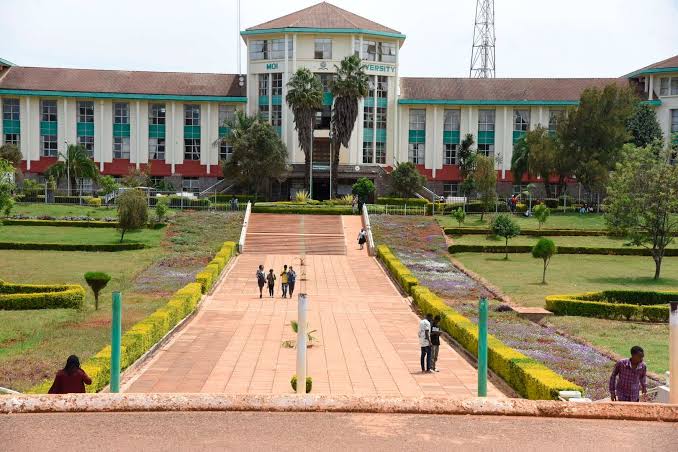
Moi University lost another legal battle after failing to correct defective appeal notices despite receiving warnings. The dispute stems from a construction project dating back to 1990, with the Court of Appeal awarding costs to Vishva Builders Limited.
Moi University has suffered another legal setback after the Court of Appeal rejected its attempt to revive an appeal against KSh185. 5 million judgement favouring Vishva Builders Limited.
In a ruling delivered on October 2, 2026, three appellate judges dismissed the university’s challenge to an earlier refusal to extend time.
The bench found no reason to overturn Justice John Mativo’s January 23, 2026, decision denying the university additional time.
The dispute centred on the university’s failure to correct defective notices after the contractor challenged their validity.
“The learned judge arrived at a well-reasoned decision backed by the law and facts as presented before him,” the court stated.
The ruling was delivered by appellate judges Mwaniki Gachoka, Nduma Nderi and Linnet Ndolo.
Historic Dispute
The legal battle originated from a construction contract awarded in 1990 for Moi University’s Faculty of Science complex.
Vishva Builders was contracted to construct science buildings and associated external works at the university’s main campus.
The original tender was valued at approximately KSh547.7 million before negotiations reduced the contract sum to KSh476.37 million.
The contractor subsequently claimed outstanding payments after disagreements emerged over completed works and the project’s progress.
Vishva Builders filed its suit in March 1999, beginning litigation that would stretch across several judicial proceedings.
On February 2, 2024, the High Court awarded the contractor KSh185,500,068 against the university.
Moi University filed its first notice of appeal on February 5, 2024, signalling its intention to challenge the judgement.
It also requested typed proceedings that day as part of preparations for the intended appeal.
A second notice followed on March 8, 2024, challenging a separate ruling on costs delivered on March 1.
Those notices later became the university’s biggest procedural obstacle in challenging the judgement.
Missed Opportunity
Vishva Builders challenged the notices through an application dated April 7, 2025, citing failures concerning service.
The company sought to have the notices struck out or treated as withdrawn and requested cancellation of existing stay orders.
The Court of Appeal allowed that application on November 24, 2025, striking out the notices and setting aside the stay orders.
Moi University immediately sought another opportunity, applying for an extension of time on the same day.
It argued that its former advocates, Nyairo & Company Advocates, had assured it that procedural requirements were satisfied.
The university relied particularly on an August 15, 2025, letter allegedly confirming compliance with Rule 79.
It maintained that it had trusted its lawyers and should not suffer because of their alleged mistakes.
However, Mativo rejected that explanation on January 23, 2026, finding insufficient grounds for granting additional time.
The judge noted that the university had already received notice of the defects through the contractor’s application.
Its current advocates had entered the record on April 14, 2025, but no corrective action followed.
The notices were eventually struck out without the university having remedied the service problems.
Lawyers’ Mistake
Moi University subsequently asked a full bench to overturn Mativo’s decision, arguing that he had overlooked relevant considerations.
It cited the Supreme Court decision in Salat v IEBC, arguing that extension applications require broader consideration.
These factors included the intended appeal’s prospects, potential prejudice to the contractor and the public interest.
The university also invoked legal authorities supporting the principle that mistakes by advocates should not automatically prejudice clients.
Vishva Builders opposed the reference, arguing that the university had failed to explain its prolonged delay satisfactorily.
The contractor also described the intended appeal as frivolous, claiming the university had admitted liability during the original proceedings.
The three judges examined whether Mativo had misdirected himself, ignored relevant evidence or reached a plainly wrong conclusion.
Under Rule 57 of the Court of Appeal Rules, their role was limited to reviewing his exercise of discretion.
They found no evidence that Mativo had overlooked relevant matters or relied on irrelevant considerations.
The judges also rejected the argument that the former lawyers’ assurance justified the university’s failure to act.
The defects had been brought to the university’s attention well before November 2025.
That warning, followed by prolonged inaction, weakened the university’s argument that its lawyers alone caused the problem.
The judges consequently dismissed the reference and awarded costs to Vishva Builders.
Financial Implications
The ruling represents a procedural defeat rather than a fresh determination of the original construction dispute.
It does not independently determine whether the contractor has received payment under the underlying judgement.
The dispute has also featured separate enforcement proceedings concerning the outstanding award and accumulated interest.
In June 2026, the Daily Nation reported that Vishva Builders had withdrawn a High Court suit following a settlement.
That reported development concerned separate enforcement proceedings and should not be confused with the October appellate ruling.
The latest decision instead addressed whether Moi University deserved additional time to challenge the earlier judgement and costs ruling.
READ ALSO: Mombasa Cement in KSh73.7 Million Debt Fight with Affordable Housing Contractor
Its central lesson concerns litigation discipline: parties must act promptly when procedural defects threaten their cases.
The court acknowledged that procedural irregularities can sometimes be corrected without sacrificing substantive justice.
However, that principle does not guarantee relief when litigants fail to address defects after receiving notice.
For Moi University, the attempt to blame its former lawyers failed to overcome evidence of prolonged inaction.
The judges upheld Mativo’s decision and ordered the university to pay Vishva Builders’ costs of the reference.
The ruling underscores the consequences of missed appellate deadlines, even when substantial public resources are involved.
PAY ATTENTION: Reach us at info@gotta.news.