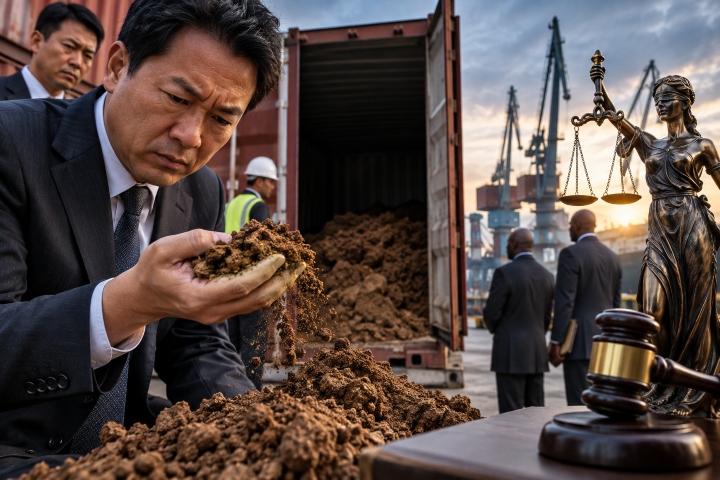
A Chinese buyer wired millions for a mineral shipment, only to find mud inside the containers. Justice Benjamin Musyoki ruled ARA failed to prove the money was criminal proceeds.
The High Court has rejected an attempt to forfeit nearly KSh124 million linked to an alleged mineral scam.
Justice Benjamin Musyoki found that the Assets Recovery Agency (ARA) failed to connect the funds with criminal beneficiaries.
The money included US$949,463.41 (KSh122 million) and KSh2.47 million held at Sidian Bank by Mose and Company Advocates.
The judgement followed a bitter dispute involving a Chinese buyer, Kenyan traders, and a Nairobi law firm.
At its centre was a shipment supposedly containing 84 metric tonnes of tantalite-niobium ore.
Instead, Chinese authorities found ordinary soil or mud inside containers shipped from East Africa.
The discovery triggered criminal investigations, preservation orders, and separate commercial proceedings involving the disputed funds.
Justice Musyoki delivered the judgement in Nairobi on September 18, 2026.
Missing Ore
The dispute began after Yingcheng (Shenzhen) International Trade Company Limited agreed to purchase mineral ore.
The Chinese company entered commercial arrangements with Sanjola Limited for the proposed shipment to China.
Sanjola Limited is associated with Patrick Lumumba Ulundu.
Mose and Company Advocates became involved after being appointed to hold the purchase money.
According to the judgement, Yingcheng eventually transferred US$1 million (KSh 129) into the firm’s escrow account.
Earlier payments brought the company’s total exposure to US$1.28 million (KSh 166 million) during the transaction.
The shipment was represented through several containers travelling from Uganda through Kenya before reaching China.
One container entered Kenya through Malaba before reaching a Mombasa container terminal.
The cargo was then transferred into other containers before continuing its journey to China.
When the shipment arrived, Yingcheng discovered discrepancies involving container seals, weights, and the expected cargo.
Two containers reportedly contained bags, while another contained metal drums filled with ordinary soil.
A report dated January 25, 2024, confirmed the condition of the cargo, according to court records.
Yingcheng immediately sought to stop release of the remaining funds after discovering the alleged deception.
The company also reported the matter to authorities and began separate proceedings seeking recovery.
ARA received information about suspected fraud on September 19, 2024, according to investigator Bernard Gitonga.
The agency obtained investigative and restriction warrants from the Milimani Chief Magistrate’s Court the following day.
Money Trail
ARA later sought forfeiture, arguing that the preserved money represented proceeds connected to fraudulent representations.
Investigators traced the funds from Yingcheng into the advocates’ escrow account before subsequent transfers.
Part of the money eventually moved into two Sidian Bank cash-margin accounts.
Those accounts held US$949,463.41 and KSh2,469,558 when targeted by the recovery agency.
ARA alleged the money resulted from obtaining funds through false pretences and related laundering offences.
The agency argued that its investigations had established a direct connection between crime and the money.
However, Justice Musyoki drew a critical distinction between criminal conduct and criminal proceeds.
The judge accepted that evidence established an offence had probably been committed during the transaction.
But that finding alone did not automatically transform Yingcheng’s money into proceeds of crime.
Justice Musyoki stressed that ARA carried the initial burden of establishing that crucial criminal connection.
He cited Supreme Court authority requiring investigators to establish a nexus between property and criminal activity.
The court found that the funds’ origin and movement were largely undisputed throughout these proceedings.
Yingcheng produced agreements and remittance records showing how the money reached the escrow account.
ARA never alleged that the Chinese company’s money originated from an illegitimate source.
The funds remained traceable from Yingcheng through Mose and Company’s account into Sidian Bank.
That traceability became central to the court’s eventual refusal to order forfeiture.
Innocent Victim
Justice Musyoki accepted that the evidence showed an offence occurred but identified Yingcheng differently.
He described the company as a victim whose money remained traceable throughout the disputed transaction.
The judge noted that Yingcheng became the complainant in criminal proceedings arising from the alleged fraud.
One alleged perpetrator, Lumumba Ulundu Patrick, faced charges involving conspiracy and obtaining money through false pretences.
Yet ARA had not produced evidence showing Mose and Company participated in the alleged criminal scheme.
The firm’s acknowledged role was receiving and holding the purchase money as an escrow agent.
“Receipt of money in that capacity does not, without more, make the advocate a beneficial owner,” Justice Musyoki ruled.
The judge also questioned why identified alleged perpetrators were absent from the forfeiture proceedings.
Their absence mattered because an apparently innocent victim stood to lose the preserved funds.
The court consequently rejected any suggestion that escrow receipt alone established beneficial ownership.
That finding weakened ARA’s attempt to convert the disputed commercial funds into forfeitable property.
The judgement also recognised that Yingcheng acted quickly after discovering the allegedly fraudulent cargo.
It stopped the money’s release, contacted law enforcement, and pursued commercial proceedings against involved parties.
Those actions, the judge said, were inconsistent with attempts to conceal or benefit from criminal proceeds.
Commercial Battle
Despite recognising Yingcheng as an apparent victim, the court declined to release the money directly.
That decision reflected competing contractual claims already pending before other courts.
The dispute had generated commercial proceedings involving Sanjola, Yingcheng, Mose and Company, and Sidian Bank.
The court had not received sufficient evidence to determine the parties’ ultimate contractual entitlements.
Justice Musyoki, therefore, invoked sub judice principles to avoid conflicting decisions between courts.
He said commercial courts remained the appropriate forums for resolving ownership and contractual questions.
The judge particularly declined to determine a disputed US$50,500 (KSh 6.6 million) transfer allegedly converted into Kenyan shillings.
He said agreements, escrow instructions, fee notes, and complete bank statements were insufficiently presented.
Those questions, he held, belonged within the wider commercial dispute rather than forfeiture proceedings.
Justice Musyoki consequently warned against expanding ARA’s mandate into private debt recovery.
“If indeed there will be proof of fraud, the victim will be entitled to restitution,” he stated.
He added that ARA’s mandate protects the public from criminal enterprise rather than private contractual disputes.
The judge cautioned that ARA should not become a “debt collector” for failed commercial transactions.
The court dismissed ARA’s originating motion and awarded costs to Mose and Company Advocates.
It also rejected Yingcheng’s application seeking immediate release of the disputed funds.
However, the court rescinded preservation and restriction orders issued over the accounts in October 2024.
The decision leaves the commercial courts to determine who ultimately has rights over the money.
The judgement therefore creates an unusual outcome for all parties involved in the dispute.
ARA cannot forfeit the money, while Yingcheng cannot immediately recover it through these proceedings.
READ ALSO: Chinese National Denied Bond in KSh151 Million Uganda Fraud Case
Instead, the funds return to the broader commercial arena for determination of competing contractual claims.
The judgement ultimately draws a firm boundary around civil forfeiture powers under POCAMLA.
Evidence of fraud does not automatically make every dollar passing through that transaction criminal property.
ARA must still establish the legally required connection between the property and criminal benefit.
That distinction ultimately saved the disputed funds from being transferred to the state.
PAY ATTENTION: Reach us at info@gotta.news.