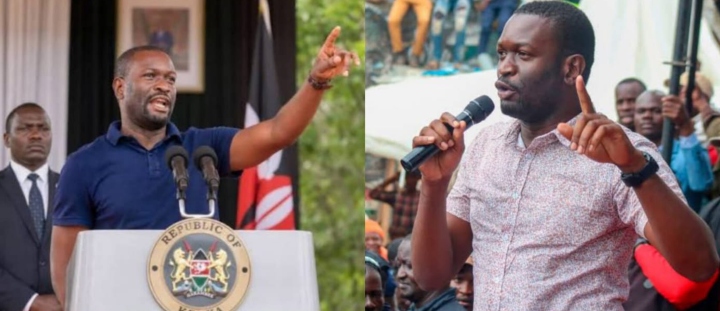
The first thing you notice is not the man. It is the absence of spectacle.
No blaring sirens. No convoy of SUVs forcing their way through traffic. No designer suits crafted to showcase wealth before a single word is uttered.
Instead, Nairobi Senator Edwin Sifuna walks onto political stages in a plain Lacoste polo shirt, dark trousers and ordinary shoes.
Navy one weekend. Olive green the next. Sometimes a patterned short-sleeved shirt.
He looks less like a politician auditioning for power than a lawyer who has wandered into a town hall after work.
Then he begins to speak.
Within minutes, smartphones rise above the crowd. Clips race across X, TikTok, Facebook and YouTube.
The comments fill with a phrase that has become one of Kenya’s most unexpected political slogans: “Sisi Ndio Sifuna.”
Whether it is a fleeting internet fad or the birth of a genuine political movement remains impossible to tell.

Nairobi Senator Edwin Sifuna speaking at a past political rally. Photo/courtesy
But it raises a question that only months ago would have sounded improbable.
Is This Becoming Sifuna’s Moment?
For several years now, Sifuna has built a reputation as one of Kenya’s most outspoken political communicators.
Long before whispers of State House gathered around his name, he had carved out an identity as a relentless critic of corruption, weak institutions and what he frequently describes as a political culture that rewards loyalty over competence.
One revealing exchange came during a public discussion with the late former cabinet minister Cyrus Jirongo.
Rather than delivering the usual campaign platitudes, Sifuna wrestled with a more uncomfortable question: can Kenya genuinely reform, or has corruption become embedded in the country’s political DNA?
It was less a speech than an interrogation of the Republic itself.
That consistency has become central to his appeal.

Edwin Sifuna with Linda Mwananchi, co-principal James Orengo. Photo/courtesy
Unlike politicians who discover the language of reform only when elections approach, Sifuna’s message has remained remarkably stable whether speaking in Parliament, television studios or roadside rallies.
Supporters say he sounds like the same man regardless of the audience.
That reputation grew sharper after the emergence of the Broad-Based Government, after ODM joined the William Ruto-led Kenya Kwanza administration.
While many ODM politicians softened their criticism following new political alignments, Sifuna continued arguing that government must remain accountable irrespective of who occupies power.
His participation in the Linda Mwananchi movement further reinforced the image of a politician prepared to challenge even his own political establishment.
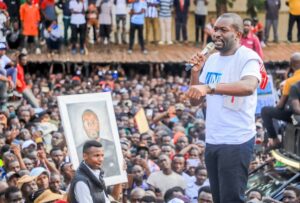
It is against that backdrop that talk of a presidential bid has gathered momentum.
For months, supporters have openly urged him to contest the presidency, transforming “Sisi Ndio Sifuna” from an online slogan into a broader political identity.
In recent interviews, however, Sifuna has been careful not to confuse public excitement with political readiness.
He has repeatedly argued that a presidential campaign cannot be built on enthusiasm alone. Winning State House, he says, requires political structures, nationwide organisation and broad alliances.
He has also insisted that defeating President William Ruto would require a united opposition rather than competing egos.
Presidential Dream
Even so, his name is increasingly being mentioned in conversations once reserved for Kenya’s political heavyweights.
Last week, a section of Western Kenya leaders publicly endorsed him as their preferred presidential flagbearer, adding fresh fuel to speculation that his ambitions are becoming more than theoretical.
Yet social media popularity is not a presidential campaign.
Kenya’s electoral history is littered with politicians who dominated online conversations but failed to build nationwide political machinery.
Digital enthusiasm rarely survives the realities of ethnic arithmetic, campaign financing and grassroots organisation.
Sifuna faces those same obstacles.
He must persuade voters beyond Nairobi, navigate ODM’s internal politics, build alliances across regions and, ultimately, convince Kenyans that he offers more than persuasive criticism.
Charisma may launch a campaign, but presidencies are won through organisation, policy and numbers.
Still, something undeniably different appears to be unfolding.
Perhaps for the first time in years, many young Kenyans are discussing a politician primarily because of his ideas rather than his surname or ethnic bloc.
That subtle shift may prove more significant than opinion polls.
His public image also stands apart from Kenya’s increasingly extravagant political culture.
While many senior politicians have embraced luxury watches, designer wardrobes and conspicuous displays of wealth, Sifuna projects restraint.
Not poverty. Not calculated populism. Simply moderation.
In a country battered by unemployment, high taxes and rising living costs, symbols matter. Modesty can communicate accessibility in ways expensive tailoring often cannot.
Equally important is his language.
No Instant
Rather than promising instant transformation, Sifuna often speaks with a realism bordering on frustration.
Entrenched Corruption Networks
His now-famous lament that “this country cannot be helped” resonated because many Kenyans recognised it not as surrender, but as exhaustion with a system where scandal repeatedly outlives outrage.
Those are conversations echoed daily in matatus, university hostels, offices and WhatsApp groups.
Why does corruption survive every administration?
Why do institutions remain so fragile?
Why does merit so often lose to patronage?
Sifuna did not invent those questions.
He simply refuses to stop asking them.
His critics are equally insistent that eloquence is not governance. They argue that dismantling entrenched patronage networks demands more than compelling speeches.
Any credible presidential candidate must eventually present detailed answers on jobs, taxation, healthcare, security and economic recovery.
That criticism is valid.
History offers no shortage of gifted communicators who struggled once entrusted with power.
Yet politics is rarely transformed by policy documents alone. It changes when a politician’s message collides with the public mood.
And Kenya today is a country where many young people feel economically excluded, politically orphaned and increasingly impatient with the old rules of power.
Whether Edwin Sifuna ultimately reaches State House remains an open question.
READ ALSO: Salasya Claims Sifuna Took Bribe to Impeach Riggy G, Says He Is Unfit for President
What is no longer in doubt is that he has become one of the defining political voices of his generation.

Perhaps, then, the real story is not Edwin Sifuna himself.
It is what the rise of “Sisi Ndio Sifuna” says about a generation still searching for a leader who speaks less like a politician seeking office and more like a citizen demanding that Kenya finally become the country it has long promised to be.
Support the journalism you love. Become a Gotta Member.
Every Gotta Membership helps fund fearless reporting, in-depth analysis, and the stories that matter most. Purchase anytime, as often as you wish, and help keep independent journalism thriving.
Join Gotta Membership today. Click HERE to check out securely with Paystack.