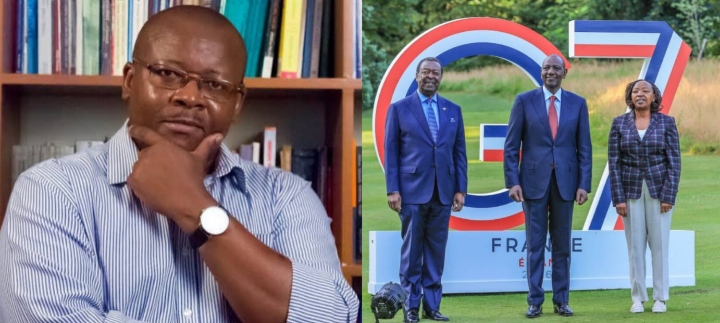
Kenyan historian and political analyst Dr Godwin Murunga has dismissed the excitement surrounding President William Ruto’s invitation to the G7 Summit in France, warning that many Kenyans are mistaking geopolitical calculation for international admiration.
As President Ruto joined some of the world’s most powerful leaders on the shores of Évian this week, supporters celebrated the invitation as further proof of Kenya’s growing influence on the global stage.
Yet even as photographs of the Kenyan leader mingling with presidents and prime ministers dominated headlines and social media timelines, Murunga offered a starkly different interpretation.
“There are very many reasons why advanced G7 countries invite a handful of non-G7 members into their meetings,” Murunga said.
“Mere optics is one of them.”
His remarks cut directly against a narrative advanced by government allies, who have portrayed Ruto’s presence at the summit as a diplomatic triumph and a sign of Kenya’s rising stature in international affairs.
But Murunga argued that the symbolism surrounding such invitations often obscures a more complex reality.
While some have celebrated Ruto as Africa’s representative at the gathering, the historian dismissed that characterisation, saying it reflects a flawed understanding of how global power operates.
“Let’s not forget the stupidity behind the assumption that the G7 can decide who represents a continent,” he said.
Strategic Importance
Photos of President Ruto at the summit ignited debate on Tuesday, June 16.
On one side were supporters who viewed the invitation as recognition of Kenya’s strategic importance in global affairs.
On the other were critics who questioned whether the honour reflected genuine influence or merely the interests of the world’s richest nations.
That question lies at the heart of Murunga’s critique.
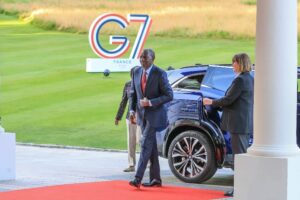
President William Ruto arrives at the G7 summit in France. Photo/courtesy
The G7, a bloc of wealthy industrialised countries, routinely invites selected non-member states to discussions on issues ranging from trade and debt to security and climate policy.
Murunga argued that these invitations, often presented as gestures of inclusion, ultimately reflect interests rather than sentiment.
“The more important reason is that the person selected will, for whatever reason, be great at advancing the interests of the G7,” he said.
From there, Murunga broadened his argument beyond the summit itself, drawing on Africa’s long history of engagement with powerful foreign states.
In his view, the continent has repeatedly witnessed external powers cultivating local allies willing to advance agendas that do not necessarily serve the interests of their people.
“Many forget that the manner in which colonialism and neo-colonialism have worked is to identify and co-opt pliant collaborators able to sell the colonised out,” he said.
The sharp remarks have amplified an already simmering conversation about Kenya’s place in an increasingly fragmented global order.
They have also exposed a deeper divide over how diplomatic recognition should be interpreted , as a measure of influence or as a reflection of strategic usefulness.
For Murunga, the issue extends far beyond President Ruto or the summit in France.
Instead, it raises enduring questions about power dynamics, representation, and whose interests are prioritised when global elites convene out of public view.
“So before you celebrate the greatness of whoever is representing a continent at the G7,” he warned, “such an exhibit of raw ignorance is repugnant.”
PAY ATTENTION: Reach us at info@gotta.news.