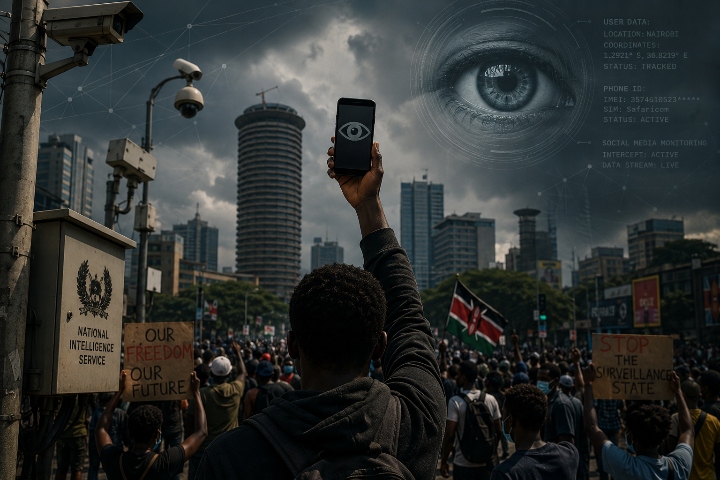
Editor’s Note: Our senior writer Getty Soila digs into the growing claims that President William Ruto’s administration intensified digital surveillance and spying operations in the wake of the explosive 2024 Gen Z protests.
On a cold Nairobi night during the Gen Z protests, a young activist switched off his phone, wrapped it in a hoodie and shoved it beneath a mattress, convinced he was safe.
Hours later plainclothes officers still found him. No warrant. No explanation.
Just a white Subaru, a blindfold and another disappearance folded into Kenya’s growing archive of fear.
That story that was debated animatedly across WhatsApp and X Spaces now captures the darker mood hanging over Kenya nearly two years after the June 2024 protests shook President William Ruto’s government.
What began as a tax revolt has spiralled into something far larger: an accelerating surveillance state powered by billions in security spending, expanding intelligence powers and increasingly sophisticated spyware technology.
Kenya once marketed itself as East Africa’s Silicon Savannah, a sleek digital republic where M-Pesa transformed commerce and smartphones became tools of empowerment.
But critics now say that same digital ecosystem is being repurposed into a vast machine for monitoring dissent.
The turning point came when Gen Z protesters, leaderless, decentralised and organised almost entirely online, flooded the streets in June 2024.
READ ALSO: The Slow Death of Kenya’s Legacy Media – And Why Democracy Should Worry
TikTok videos replaced political rallies. Anonymous designers produced viral protest graphics.
X Spaces became command centres.
Then Parliament burnt. When protesters breached Parliament on June 25, 2024, the state appeared blindsided by the scale of the uprising.
Digital Counteroffensive
What followed, activists say according to a recent feature by Aljazeera, was a digital counteroffensive.
Security agencies escalated phone triangulation, geolocation tracking, social media monitoring and facial-recognition surveillance to identify protest organisers before demonstrations could regroup.
Suddenly, online anonymity in Kenya felt mythical.
Tweets vanished minutes after posting. Activists rotated SIM cards like fugitives changing disguises.
Others stopped carrying phones entirely, fearing the device in their pocket had become an informer.
Amnesty International documented at least 83 enforced disappearances and more than 128 killings linked to the protest crackdown.
Rights groups say many abducted activists were traced through their digital footprints.
And as public fear deepened, Kenya’s security budgets quietly ballooned.
Parliamentary and Treasury records show the National Intelligence Service (NIS) budget rose from about KSh 43.8 billion in 2023 to KSh 45.8 billion in 2024 before jumping again to roughly KSh 51.4 billion in 2025.
Meanwhile, the Ministry of Defence allocation surged from around KSh 173 billion in the 2023/2024 budget cycle to nearly KSh 200 billion in 2024/2025, part of a wider national security budget now approaching half a trillion shillings.
Critics argue that while officials publicly frame the spending around terrorism and border security, the timing has raised uncomfortable questions.
Especially because Kenya already possesses one of the region’s most advanced surveillance infrastructures, including Chinese-built CCTV networks, biometric databases and facial-recognition systems rolled out after attacks like Westgate, Garissa University and DusitD2.
Spyware
Now attention has shifted to spyware.
Rumours have swirled for years that Kenya either acquired or mulled acquiring Pegasus, the infamous Israeli-made spyware developed by NSO Group.
Pegasus is among the world’s most invasive hacking tools.
Once secretly installed on a phone, often through “zero-click” exploits requiring no user interaction, it can access messages, passwords, microphones, cameras and live location data.
Globally, Pegasus licenses reportedly cost governments millions of dollars, with media investigations previously estimating packages running into tens of millions depending on the number of targets.
Mexico alone reportedly spent more than $60 million (over KSh 70B) on the technology.
But despite persistent speculation, there is still no publicly verified evidence proving the Kenyan government officially purchased Pegasus.
However, there are repeated allegations of unlawful digital surveillance inside Kenya.
Safaricom
At the centre of that storm sits Safaricom, the telecom giant controlling much of Kenya’s mobile communication and financial data.
Privacy watchdogs have long accused the company of granting security agencies informal access to subscriber information without court authorisation. Safaricom has denied the allegations.
However, public suspicion exploded during the prosecution of David Mokaya, a college student accused of sharing an AI-generated image depicting President Ruto in a coffin.
During court proceedings, testimony suggested police obtained his location data and communication records without a court order.
For many Kenyans, that moment landed like a thunderclap.
The fear today is no longer abstract. It is ambient.
READ ALSO: Westgate Mall Attack: The Haunting Photo That Turned Benjamin Chemjor Into Kenya’s Symbol of Courage
Critics warn that surveillance does not merely track dissent; it slowly reshapes society itself.
When citizens begin assuming every message can be intercepted, every movement mapped and every conversation overheard, self-censorship quietly takes root.
And once fear colonises private thought, democracy itself begins to shrink in silence.
Support the journalism you love. Become a Gotta Member.
Every Gotta Membership helps fund fearless reporting, in-depth analysis, and the stories that matter most. Purchase anytime, as often as you wish, and help keep independent journalism thriving.
Join Gotta Membership today. Click HERE to check out securely with Paystack. For any enquiry, reach us at info@gotta.news.