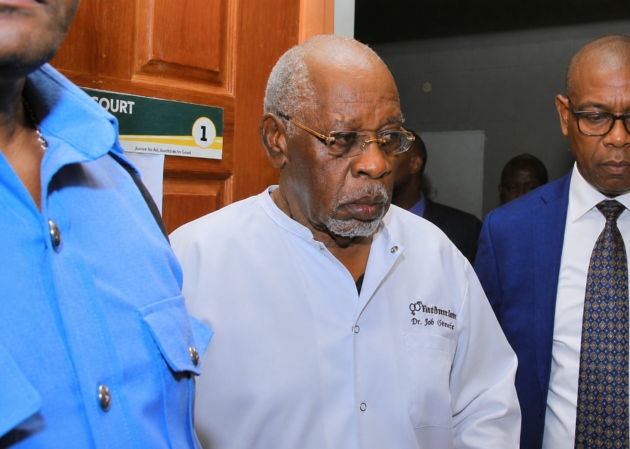
A postmortem conducted on the prominent medic and Nairobi Hospital board member confirmed that Dr Job Obwaka died from cardiac arrest.
For days, social media timelines crackled with theories. Private conversations turned feverish.
Claims and counterclaims spread with the speed of wildfire as friends, colleagues and curious Kenyans tried to piece together the doctor’s final hours.
But beneath the noise lay a quieter and far more frightening reality: the frailty of the human heart.
Reports emerging after the autopsy indicated that Dr Obwaka had been battling a heart-related condition before his death.
Medical experts say that detail is critical because cardiac arrest is rarely a random event. More often, it is the violent final chapter of an underlying cardiovascular problem that has been building silently over time.
One second a person is talking, walking or laughing. Next, the body shuts down with terrifying suddenness.
Does age matter kwa relationship?….If so, when?
43 yr old Beatrice Wangare, the woman arrested as a person of interest following the death of Dr. Job Obwaka, told the court she was in a romantic relationship with the renowned gynaecologist.
Dr Obwaka was 83 years.#Brekko pic.twitter.com/6aqwWZJ1LO— Ghetto Radio (@GhettoRadio895) May 6, 2026
Doctors describe cardiac arrest as an abrupt electrical malfunction in the heart that stops it from pumping blood to the brain and vital organs.
Without immediate intervention, death can occur within minutes.
The silent collapse inside the body
Specialists say underlying conditions such as coronary artery disease, irregular heartbeat, chronic hypertension and enlarged heart muscles are among the leading triggers of sudden cardiac arrest worldwide.
Research from major cardiac institutions shows that many victims often appear functional and active shortly before collapse, masking the dangerous stress accumulating inside the cardiovascular system.
For high-performing professionals like Dr Obwaka, whose life revolved around hospital wards, emergency calls, boardroom meetings and relentless schedules, the strain can be immense.
Cardiologists have repeatedly warned that stress, exhaustion and unmanaged heart disease can become a deadly combination.
And yet cardiac illness often advances quietly.
Dr Job Obwaka died of cardiac arrest, family representative Joseph Ndungu says after postmortem examination pic.twitter.com/OF2fCZ1rKN
— Daily Nation (@NationAfrica) May 5, 2026
There are cases where warning signs emerge subtly through fatigue, chest discomfort, dizziness or shortness of breath. In others, the first major symptom is collapse itself.
That brutal unpredictability is part of what makes cardiac arrest so feared in medicine.
Is heart attack same as cardiac arrest?
In the aftermath of Dr Obwaka’s death, many Kenyans have used the terms “heart attack” and “cardiac arrest” interchangeably. Medically, however, they are very different events.
A heart attack happens when blood flow to part of the heart muscle becomes blocked, usually by a clot or narrowed artery.
The heart often continues beating during a heart attack, although damage may be occurring internally.
Cardiac arrest is far more sudden and catastrophic.
It is an electrical failure in which the heart abruptly stops pumping blood effectively, causing immediate collapse, loss of consciousness and, if untreated, death.
A heart attack can trigger cardiac arrest, but cardiac arrest may also arise from other serious heart conditions.
READ ALSO: Inside Dr Obwaka’s Final Hours: Secret Affair, Shared Meal and a Sudden Death Under Probe
Medical experts distinguish between the “cause of death” and the “mechanism of death“.
In Dr Obwaka’s case, cardiac arrest was the mechanism, the final shutdown of the body’s circulatory system, while the underlying heart ailment may have been the deeper medical condition that set the fatal chain in motion.
PAY ATTENTION: Reach us at info@gotta.news