
Editor’s Note: In light of Nairobi Senator Edwin Sifuna’s candid insights into the workings of government, Jasper Onyango from Homa Bay explores Kenya’s deeply ingrained culture of looting – a system that not only hinders development but also causes significant suffering for millions of citizens.
A video circulating widely on TikTok has revived a quiet but unsettling admission from Nairobi Senator Edwin Sifuna.
Speaking in an interview with the late politician Cyrus Jirongo, Sifuna recalled the moment he first entered Parliament.
It was supposed to be a moment of pride. Instead, it left him troubled.
“The thing called government is very complex,” he said.
“There are things you see and observe, and you are tempted to conclude that this country cannot be helped.”
For many Kenyans, the remark sounded less like frustration.
And more like truth.
Sifuna suggested that inside government exists something deeper than bureaucracy – an infrastructure that quietly blocks anything that might genuinely benefit ordinary citizens.
Policies that make sense stall.
Decisions that defy logic move forward.
And one question lingers:
Who benefits?
Certainly not the people.
The SHA scandal
That question has returned with force in the latest corruption storm surrounding the Social Health Authority (SHA).
The agency was created to replace the troubled NHIF and deliver universal health coverage.
The promise was reform. The reality has been something else.
Investigations have uncovered a troubling pattern: billions of shillings reportedly syphoned off through fraudulent claims, the existence of ghost hospitals, and falsified patient records.
Some facilities receiving payments reportedly exist only on paper.
Within just a few months of its operation, approximately KSh11 billion had already been flagged for suspicious claims linked to non-existent hospitals and fraudulent treatments.
While the money flowed out, the real system stalled. Hospitals waited months for reimbursement.
Doctors struggled to keep services running. Patients were turned away.
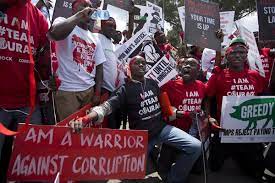
Activists in an anti-corruption march. PHOTO/COURTESY
The quiet suffering
Behind the numbers lies the human story. A mother sitting on a hospital bench for hours because her insurance cannot be verified.
A farmer selling his only piece of land to pay for surgery that public insurance was meant to cover.
A child is discharged early because the hospital can no longer absorb unpaid bills.
Corruption in Kenya rarely looks dramatic. It looks ordinary.
An empty pharmacy shelf. A broken dialysis machine.
A classroom with seventy children and one exhausted teacher.
Every stolen billion quietly reshapes thousands of lives.
Politics as business
The deeper problem lies in the nature of power itself. For many politicians, public office is not a responsibility.
It is an investment. Campaigns cost millions. Supporters expect rewards. Networks of patronage must be fed.
Once elected, the state becomes the return on investment. Tender cartels emerge. Budgets expand.
Procurement deals inflate. And the public treasury becomes the prize. Across party lines, the pattern repeats.
Waste becomes routine. Looting becomes normal.
The system protects itself
Even when scandals explode, consequences are rare. Committees are formed. Investigations are announced.
Reports are written. Then silence. The system closes ranks. Occasionally, a few honest leaders speak out.
But their voices are often drowned in a political environment where corruption is not an aberration.
It is the operating system.
The voter’s trap
Kenya’s elections rarely break this cycle. For six consecutive general elections, the script has been painfully familiar.
Candidates with questionable reputations win office. Scandals erupt. Public anger rises.
Four years later, many of the same leaders return. The reasons are complex. But poverty plays a brutal role.
In communities where daily survival is uncertain, political promises compete with immediate cash.
A few thousand shillings on election day can outweigh the distant promise of reform.
Votes become commodities. Power becomes purchasable.
A nation held back
The long-term cost is enormous. Kenya is a country bursting with talent, energy and ambition.
Yet progress often feels stalled. Infrastructure projects are delayed. Public services are strained.
Young people grow increasingly cynical about politics. Many no longer believe government exists to serve them.
Instead, they see a system designed to enrich a few while the majority struggles.
The uncomfortable truth
This is why Sifuna’s reflection resonates. It captures the moment when observers of Kenyan politics confront a painful possibility.
That the barriers to reform are not accidental. They are structural.
That somewhere within the machinery of government exists an infrastructure designed to keep the system exactly as it is.
READ ALSO: Kenya Didn’t Fail – Its Politics Failed It
Where change begins
History offers one stubborn lesson. Systems that appear permanent rarely are. But change rarely begins inside Parliament.
It starts beyond the confines of Parliament, with citizens who have reached their limit with corruption and are determined to stop funding it.
We welcome writers to give their views on various social and political issues. Send your opinion to info@gotta.news.