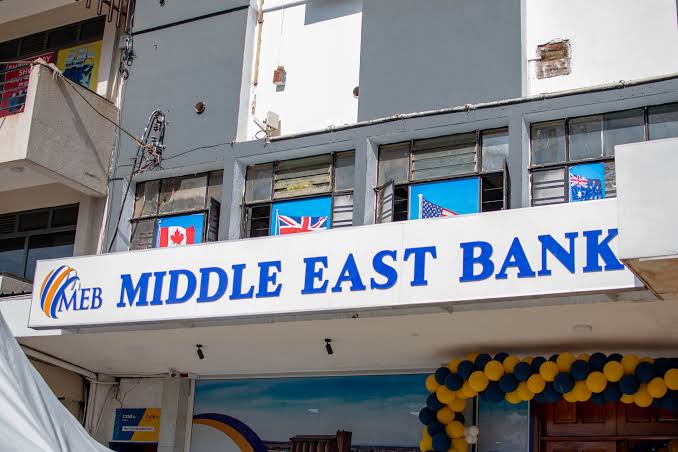
Middle East Bank Kenya has secured a crucial courtroom reprieve after the High Court suspended enforcement of a KSh18.56 million judgment, handing the lender breathing space while it pursues an appeal over a long-running commercial dispute involving Nairobi Glass & Motor House and EPCO Builders Ltd.
In a ruling delivered on July 15, Justice Anthony Mrima stayed execution of a judgement issued by the Nairobi Chief Magistrate’s Commercial Court, concluding that the bank had satisfied the legal threshold required for such protection.
The decision does not determine the merits of the appeal. Instead, it preserves the status quo, ensuring that none of the parties gains an irreversible advantage before the appellate court hears the substantive dispute.
At the centre of the battle is a judgement delivered on July 10, 2025, in Commercial Suit No. 9055 of 2018.
The lower court ordered Middle East Bank to pay Nairobi Glass & Motor House KSh18,565,166.40, together with interest.
It also dismissed the bank’s claim seeking full indemnity from EPCO Builders Ltd, leaving the lender exposed to the financial burden arising from the dispute.
High Court
Rather than immediately satisfy the decree, the bank challenged both findings before the High Court.
It argued that enforcement should wait until the appeal is heard and determined.
That request has now succeeded.
Justice Mrima anchored his reasoning on the well-established principles governing applications for stay of execution, particularly the landmark decision in Butt v Rent Restriction Tribunal [1979] eKLR and the requirements contained in Order 42 Rule 6(2) of the Civil Procedure Rules.
Those principles require an applicant to demonstrate promptness, provide adequate security and convince the court that granting a stay serves the interests of justice.
The judge found Middle East Bank had cleared those hurdles.
First, he observed that the lender had moved to court without unreasonable or unexplained delay, eliminating concerns that the application was merely intended to frustrate the successful litigant.
Equally significant was the bank’s decision to comply with an earlier court order directing it to deposit the entire decretal amount of KSh18.56 million in court.
That deposit became the turning point.
By securing the money within the court system, the bank effectively assured the respondents that the funds would remain available should the appeal ultimately fail.
For the court, that substantially reduced any risk of prejudice.
Complex Issues
Justice Mrima noted that the appeal also raises competing and complex issues, making it preferable for those questions to be fully ventilated before execution proceeds.
The judge summed up the balancing exercise in measured language.
“None of the parties will suffer substantial loss or prejudice… given the Court’s undertaking to expedite the determination of the appeal,” he ruled.
That conclusion reflects one of the central objectives of stay applications.
Kenyan courts generally seek to protect a successful litigant’s judgement while simultaneously safeguarding an appellant’s right to pursue an appeal that could otherwise be rendered meaningless if execution proceeds immediately.
Having reached that conclusion, the court issued two consequential orders.
Execution of the Chief Magistrate’s judgment was suspended pending determination of the appeal.
The judge also directed that the trial court file be transmitted to the High Court so that the appeal can proceed without unnecessary delay.
Although the ruling appears procedural, its commercial significance is substantial.
Had execution proceeded immediately, Nairobi Glass & Motor House would have been free to enforce recovery of the judgement sum despite the pending appeal.
Instead, the money now remains secured in court while judges determine whether the trial court reached the correct conclusions both on liability and on the bank’s failed indemnity claim against EPCO Builders.
The dispute itself traces back even further.
Court records show the parties have been embroiled in litigation for more than a decade over transactions involving a construction project and related commercial obligations, generating multiple proceedings before Kenya’s superior courts.
EPCO Builders
Earlier litigation between EPCO Builders, Middle East Bank, and Nairobi Glass arose from a building works agreement dating back to 2013, illustrating the lengthy commercial relationship underlying the current appeal.
That broader background explains why Justice Mrima repeatedly referred to the issues before him as both “competing” and “complex”.
Rather than prejudge those questions through an interlocutory application, the court opted to preserve the existing position until the appellate bench examines the entire record.
For Middle East Bank, the ruling buys valuable time and shields it from immediate enforcement.
READ ALSO: ‘Too Late’: Family Bank Loses Court Battle Over KSh720,000 Stolen From Customer’s Account
For Nairobi Glass & Motor House, however, the victory secured in the magistrates’ court remains intact, albeit temporarily unenforceable.
The respondent has not lost the judgement.
It must simply wait for the appellate process to run its course.
The real contest, therefore, still lies ahead.
When the appeal is eventually heard, the High Court will determine whether the KSh18.56 million award should stand, whether the trial court correctly dismissed the indemnity claim against EPCO Builders, and ultimately which party bears final responsibility for a commercial dispute that has already occupied Kenya’s courts for years.
PAY ATTENTION: Reach us at info@gotta.news.