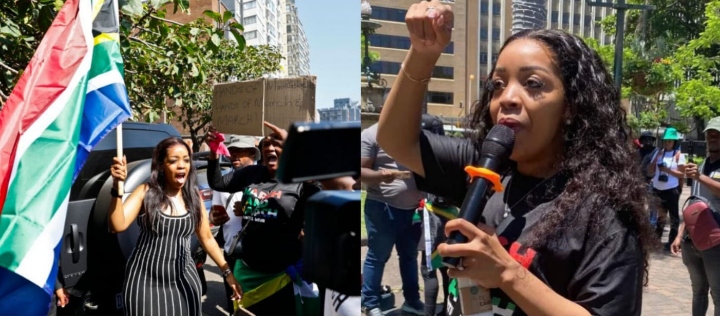
She moves through the streets like a figure carved out of anger and history, wrapped in flowing Zulu regalia, eyes blazing, voice rising above the roar of crowds and police sirens.
Around her, smartphones float in the air like lanterns documenting a country at war with itself.
Jacinta Zinhle MaNgobese Zuma has become one of the most explosive and polarising faces in South Africa’s intensifying campaign against undocumented immigrants.
In viral Facebook Live videos, TikTok clips and X posts, she speaks with the force of a revival preacher and the menace of a political insurgent.
Behind her, crowds chant struggle songs that once resonated during the apartheid era.
In front of her, Somali-owned shops hastily close their doors, Ethiopian traders swiftly retreat into alleyways, and foreign street hawkers fade into the shadows, clutching bags of unsold fruit.
To supporters, she is fearless – a woman finally saying aloud what millions of frustrated South Africans whisper in taxis, barber shops and township taverns.
READ ALSO: Betrayed Solidarity: Inside South Africa’s Recurring Attacks on Fellow Africans
To critics, she is something far darker: the elegant face of a dangerous xenophobic fire now licking across one of Africa’s most unequal nations.
Either way, she has become impossible to ignore.
“We are becoming foreigners in our own country.”
South Africa’s economic despair hangs over Jacinta Ngobese Zuma’s rise like thick smoke.
In townships around Durban and Johannesburg, unemployment sits like a permanent wound. Rusted factories stand abandoned behind razor wire.
Clinics overflow. Electricity dies without warning. Young men wander street corners all day beneath election posters promising jobs that never come.
Into that despair stepped movements like Operation Dudula — loosely translated from isiZulu as “push back” or “force out”.
The movement argues that undocumented migrants are taking jobs away from locals, placing excessive strain on hospitals, and contributing to rising crime rates.
Critics counter that immigrants are merely convenient scapegoats for decades of state failure and corruption.

Jacinta Ngobese Zuma with supporters. Photo/courtesy
MaNgobese Zuma became one of the loudest voices in that storm.
In one widely shared video, she declares: “We are becoming foreigners in our own country.”
In another, she warns: “South Africans are suffering while politicians protect illegal foreigners.”
The words land like matches in dry grass.
At her rallies, men draped in South African flags whistle and cheer while chanting, “South Africa for South Africans.”
The atmosphere often feels less like a protest than a reckoning: a boiling release of humiliation, poverty and rage.
Part of Jacinta Ngobese Zuma’s appeal lies in presentation. Unlike many firebrand activists who rely purely on rage, she often projects discipline and cultural symbolism.
Draped in traditional attire, speaking in isiZulu-inflected English, she frames herself as a defender of sovereignty rather than a mere agitator.
“We want our country’s laws to be respected,” she says repeatedly — a phrase now central to her political identity.
The haunting irony beneath the marches
There is a painful contradiction pulsing beneath the movement she represents.
South Africa was once the beating heart of pan-African solidarity.
During apartheid, African nations sheltered South African exiles, trained liberation fighters and funded the struggle against white minority rule.
Now, decades later, fellow Africans have become targets.
That irony hangs heavily over the marches Jacinta Ngobese Zuma leads.
In one haunting clip circulating online, liberation songs echo through the streets under sharp winter sunlight.
But the enemy is no longer apartheid police. The fear now settles on Zimbabwean shopkeepers, Nigerian traders and Mozambican workers peering nervously through half-closed shutters.
The imagery is unforgettable.
Children stand silently beside locked shopfronts. Mothers pull toddlers indoors as crowds pass.
Police vehicles crawl nearby like wary predators. Somewhere in the distance, someone is always filming.
Human-rights groups have repeatedly warned that anti-immigrant rhetoric risks igniting violence in a country already scarred by deadly xenophobic attacks in 2008, 2015 and beyond.
READ ALSO: WATCH: “Go Back to Nigeria” – Tense Moment as South African Gang Harass Humble Street Vendor
Still, MaNgobese Zuma’s popularity continues to surge online.
And perhaps that is because she has tapped into something larger than immigration itself.
Jacinta Ngobese Zuma was born on 6 July 1986 in KwaMashu, KwaZulu-Natal, South Africa. She graduated in supply chain management from the University of KwaZulu-Natal and is a mother of two.
Support the journalism you love. Become a Gotta Member.
Every Gotta Membership helps fund fearless reporting, in-depth analysis, and the stories that matter most. Purchase anytime, as often as you wish, and help keep independent journalism thriving.
Join Gotta Membership today. Click HERE to check out securely with Paystack. For any enquiry, reach us at info@gotta.news.