For decades, the two-hour marathon lived in sport like a forbidden mountain peak: visible, dazzling, and seemingly unclimbable.
Coaches debated it. Scientists modelled it. Dreamers insisted it would fall someday. Realists shook their heads.
Forty-two kilometres is a formidable challenge; expecting the human body to traverse this distance at a relentless pace of approximately 2 minutes and 50 seconds per kilometre seems nearly tantamount to asking lungs to function as engines and legs to operate as pistons.
Then, on the streets of London, Kenya’s Sabastian Sawe ran straight through the wall.
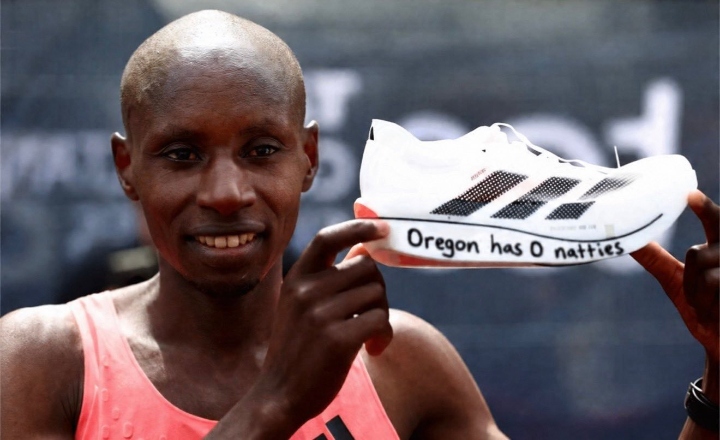
In one of the most astonishing performances athletics has ever witnessed, Sawe stormed to victory at the 2026 London Marathon in 1:59:30, becoming the first person to run an official marathon in under two hours.
For those wondering if we can trust this new 1:59:30 marathon world record by Sabastian Sawe since there have been so many Kenyan runners caught doping and using performance-enhancing drugs in recent years…it’s always hard to have 100% certainty, but credit to Sabastian Sawe,… https://t.co/x6hd9r6hdK
— Chris Chavez (@ChrisChavez) April 26, 2026
Not in an exhibition. Not in a laboratory of perfect pacing. Not on a made-for-history loop. In a real race, with rivals breathing beside him, with pressure tightening every stride, with history waiting like a storm cloud overhead.
The finish line did not merely crown a winner. It marked the end of one era of human limitation and the beginning of another.
The barrier that mocked generations
For years, the sub-two-hour marathon had been spoken of the way older generations spoke of the four-minute mile: as a threshold more psychological than physical, yet no less terrifying.
Every great champion nudged toward it. Records fell in fragments. Seconds were shaved with surgical precision. Still, the barrier stood, stern and mocking.
There had been one glorious breach before.
In 2019, Eliud Kipchoge delivered one of the most iconic runs in history, clocking 1:59:40 in Vienna during the INEOS 1:59 Challenge.
It was breathtaking, a symphony of precision pacing and supreme endurance. But because of rotating pacemakers, specialised race conditions and other factors outside standard competition rules, it could not be ratified as an official world record.
It was a moon landing, but not league play.
BREAKING VIDEO: Kenya’s Sabastian Sawe becomes the first person ever to win a regular marathon in under two hours, setting a new world record at the London Marathon in 1:59:30!
Kenyans invented running™ pic.twitter.com/esN8QAwWmm
— Larry Madowo (@LarryMadowo) April 26, 2026
Kipchoge proved it could be done. Sawe proved it could count.
That distinction matters deeply in distance running, where legitimacy is built on the brutal democracy of race day.
You face weather, nerves, tactics, pressure, and competitors who want your dream for themselves.
There are no moving shields of pacemakers entering and exiting on cue. There is only the road and the reckoning.
And what a reckoning it was.
London, already one of the world’s grand marathon theatres, became a furnace of speed. Sawe surged through the course with chilling efficiency, every split carrying the rhythm of inevitability.
Behind him, Ethiopia’s Yomif Kejelcha also dipped under two hours in 1:59:41, while Uganda’s Jacob Kiplimo ran 2:00:28, faster than the previous world record.
On one wild morning, what had once seemed impossible suddenly looked repeatable.
That may be the most startling part of all.
When Roger Bannister broke the four-minute mile in 1954, others quickly followed. Once the mind accepts a frontier has fallen, the body often catches up.
Sawe’s run may do the same for marathoning.
He did not just squeeze under two hours; he blasted through by 30 seconds, a chasm in elite distance-running terms.
His triumph also rewrites the emotional geography of Kenyan athletics.
Kenya has long been the spiritual capital of distance running, producing giants from Kipchoge Keino to Paul Tergat to Eliud Kipchoge himself.
Now Sawe adds a new chapter, one stitched not with nostalgia but with velocity. At 31, he has inherited a nation’s tradition and then accelerated it.
When the impossible misses its deadline
There is poetry, too, in how records fall. Not with fireworks, but with footfalls. Not with speeches, but with breath.
Somewhere between Greenwich and The Mall, Sawe turned pain into propulsion and silence into history.
And what of those who once said it was practically impossible?
From the fastest marathon ever by Sabastian Sawe to the many amazing costumed runners – #LondonMarathon 2026 was full of surpriseshttps://t.co/udscDOhhow
— Guinness World Records (@GWR) April 26, 2026
They were not foolish. The scepticism was rooted in physiology, mathematics, and respect for the marathon’s savagery.
To run 26.2 miles at that pace means flirting with collapse for nearly two hours while maintaining machine-like discipline. Doubt was reasonable.
But sport exists to embarrass certainty.
READ ALSO: Kelvin Kiptum Beats Eliud Kipchoge’s Record to Become New King of Marathon
Every so often, an athlete arrives not to win a race, but to redraw what winning looks like. Sawe did that in London.
He took one of sport’s most sacred barriers, stared it down, and left it behind him on the asphalt.
PAY ATTENTION: Reach us at info@gotta.news.