The story already carried the weight of tragedy when news first broke that a Kenya Defence Forces (KDF) captain had allegedly stabbed his wife to death in Nakuru.
But a new detail has sharpened the sense of collapse: Captain Edwin Kaunga Muthomi was reportedly not an ordinary officer.
He was a member of the elite 40 Ranger Strike Force (40RSF) – one of the KDF’s hardened special operations units.
That revelation, shared online by a friend identified as Denis Murangiri Muthomi, has transformed public reaction from shock to disbelief.
Because if true, it means a man trusted with some of the country’s most demanding assignments now stands accused in one of the most intimate and devastating forms of violence: the killing of his own wife.
His wife, Anita Nyambura Mugweru, was reported killed after a domestic altercation.
Social media accounts and local reports said the attack happened in the presence of their young child, a detail that has horrified many Kenyans.
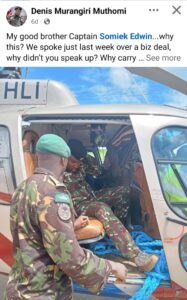
Then came the Facebook post.
“My good brother Captain Somiek Edwin… why this? We spoke just last week over a biz deal; why didn’t you speak up?” Denis wrote in a message that read less like commentary and more like a cry into the ruins.
“Why carry such heavy burdens alone when you had a shoulder to lean on?”
It was the kind of post that lands heavily because it suggests there were storms no one else could see.
The making of a Ranger
Within military circles, ranger and special forces selection is no ceremonial path. It is attrition by design.
Units such as 40RSF are associated with high-risk missions, extreme endurance standards, mental resilience, marksmanship, battlefield intelligence and operating under pressure where mistakes can be fatal.
40RSF is part of the Kenya Defence Forces (KDF) Army Special Operations Brigade (ASOB). This unit is set up to handle high-risk missions, fight insurgents, and fight unconventional wars, especially against Al-Shabaab.
The unit is trained by the US 75th Ranger Regiment and specialises in long-range surveillance and direct-action strikes.
Candidates are tested physically, psychologically and tactically. Many do not make it.
To attain the rank of captain in such a demanding environment requires enduring years of competition, discipline, and scrutiny.
It means command responsibility. The rank also means trust. It means promise.
Those who knew military progression say Muthomi, having reached captain, may have been on track for further advancement, possibly major, a rank that signals senior leadership and wider command authority.
And that is what makes the fall feel so steep.
The photograph that now feels haunted
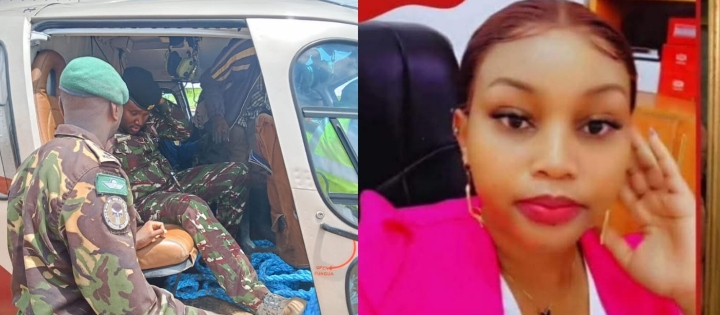
In the circulating photo shared by his friend, Muthomi appears composed, dressed in military uniform, carrying the poise of a man built by systems larger than himself.
But what has gripped viewers is the shoulder insignia and the words associated with the unit:
“God will forgive them; we’ll arrange the meeting.”
The slogan, originally meant to convey battlefield determination, now resonates with unsettling irony in light of a domestic killing allegation.
The image is haunting because it captures two men meeting in what looked like an ordinary moment: friendship, loyalty, and brotherhood.
Yet hidden beneath it, if the friend’s words are taken seriously, may have been private burdens no medals or rank could conceal.
Strength outside the uniform
Denis Murangiri’s message included another piece of advice that is currently being widely circulated:
“As officers, we must normalise checking on each other beyond the uniform… No conflict is worth a life. Walking away is strength, not weakness.”
That may be the central lesson of this case.
Uniforms often symbolise control, courage and competence. But they can also become armour that hides distress.
Across the world, militaries struggle with mental health pressures, relationship breakdowns, trauma and the silent culture that sometimes treats vulnerability as failure.
READ ALSO: KDF Rank Structure and Promotion System
If the allegations are proven, this case will not only be about crime.
It will also be about missed warning signs, conversations that were never had, and pain that spread behind closed doors.
Support the journalism you love. Become a Gotta Member.
Every Gotta Membership helps fund fearless reporting, in-depth analysis, and the stories that matter most. Purchase anytime, as often as you wish, and help keep independent journalism thriving.
Join Gotta Membership today. Click HERE to check out securely with Paystack. For any enquiry, reach us at info@gotta.news.