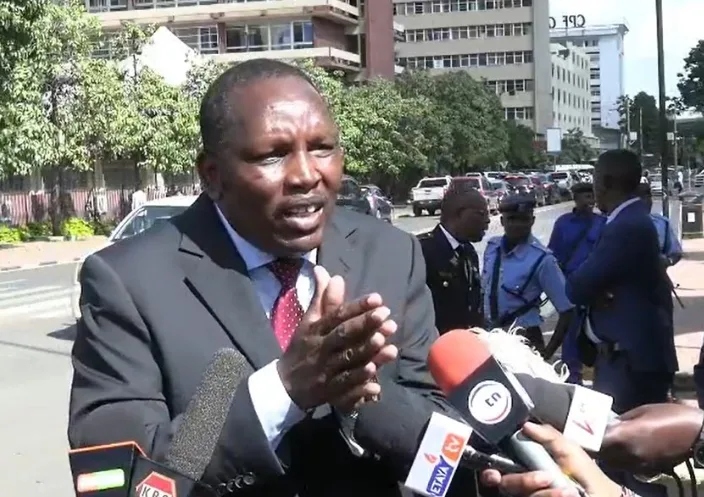
Editor’s note: From Nanyuki, Gerishon Ndichu captures a moment where power, pride, and political theatre collided in spectacular fashion when Samburu Governor Jonathan Lati Lelelit turned a Senate standoff into a sprint for the ages.
What transpired was a moment that was both revealing and remarkable, a mixture of circus and reckoning.
It began, as Kenyan political theatre so often does, with a microphone, a grievance – and a miscalculation.
In the corridors of power, accountability often accelerates the pace of events, and on this particular day, Samburu Governor Jonathan Lati Lelelit would learn – rather abruptly – just how swiftly senators can act when sufficiently provoked.
Outside the stately calm of Parliament, Lelelit did not arrive as a man braced for reckoning but as one stepping into what he may have assumed was routine political friction.
Yet what awaited him was anything but routine. The scene teetered between oversight and spectacle – less a sober institutional encounter, more an unscripted audition for prime-time wrestling.
At the centre of the storm, or at least its gravitational pull, was Nairobi Senator Edwin Sifuna.
Around him gathered a phalanx of visibly incensed lawmakers, their patience long frayed by what they saw as the governor’s casual disregard for Senate summons.
Then, as if on cue, the temperature rose. Words sharpened. Tempers snapped. Jackets strained at the seams of civility.
And just when it seemed the moment could stretch no further without breaking.
It did. The governor ran.
Drama as Samburu Governor Lelelit flees Parliament after senators attempt to forcefully drag him to the County Accounts Committee to respond to audit queries pic.twitter.com/octb7MnqZF
— Citizen TV Kenya (@citizentvkenya) April 1, 2026
The Great Samburu sprint
There are exits, and then there are exits that demand a soundtrack.
What followed was not merely a retreat but a performance – swift, instinctive, and immortalised in jittery phone footage already destined for Kenya’s digital folklore.
Governor Lelelit slipped through the tightening ring of legislators with the urgency of a man pursued not just by colleagues but by consequences.
Behind him trailed a peculiar procession: senators, aides, security, and – hovering invisibly yet unmistakably – the long shadow of accountability itself.
It was equal parts chase scene and civic metaphor. A governor in flight; an institution in pursuit.
And somewhere between them, the uneasy truth about power and responsibility in modern Kenya.
“Sifuna, come, we fight like men!”
If the sprint was theatre, the aftermath was opera.
For no sooner had the dust settled than Governor Lelelit re-emerged – not breathless, not chastened, but defiant.
Appearing on KTN News, he reached not for an apology but for audacity.
He issued a challenge.
Not the bureaucratic kind. Not the legal kind. But the ancient, chest-thumping variety that belongs more to duelling grounds than democratic halls.
“I am ready to face Sifuna as a man… even three of you,” he declared, dismissing the senators as “goons” and daring them, in effect, to settle matters the old-fashioned way.
It was bravado of cinematic proportions – Clint Eastwood by way of Capitol Hill – delivered with stirring conviction, if not entirely consistent timing.
For critics could not resist the obvious contrast: a man calling for a fight, having only moments earlier opted for flight.
Samburu Governor Lati Lelelit says he almost butchered Senator Edwin Sifuna — who begged him for mercy after hitting him. pic.twitter.com/rXIlWAsLHL
— Abuga Makori EGH, MBE (@abuga_makori) April 2, 2026
Why the Senate came calling
Beneath the spectacle lay something far less entertaining and far more familiar: the slow grind of accountability.
Governor Lelelit had been summoned by the Senate’s oversight machinery – specifically its public accounts watchdogs – over his repeated failure to appear and answer questions.
The situation had escalated to the point where an arrest warrant reportedly loomed, transforming what might have been routine scrutiny into high-stakes confrontation.
This, in truth, is the deeper rhythm of Kenyan governance: a recurring drama in which governors, public funds, and parliamentary oversight collide in cycles of defiance and pursuit. Personalities may change; the script, rarely.
Ghosts of Samburu past
Yet Lelelit’s predicament is not an isolated chapter – it is part of a longer, more troubled narrative.
Samburu County has, over time, acquired a reputation for governance turbulence, its leadership repeatedly shadowed by allegations of financial impropriety, procurement irregularities, and the perennial question of where public money goes once it disappears into the machinery of county administration.
In that context, the governor’s sprint begins to look less like a spontaneous dash and more like a metaphor in motion: a leadership culture that runs – sometimes literally – ahead of questions it has yet to answer.
The curious case of the cheering crowd
And then, just as the story threatened to settle into familiar cynicism, came its most confounding twist.
The people. Back in Samburu, protests reportedly broke out – not in outrage over the allegations nor in demand for clarity – but in defence of the governor, framed as a victim of mistreatment at the hands of overzealous senators.
It was a tableau of striking contradiction. A county long acquainted with hardship, rising not to interrogate power but to shield it. Not to question, but to cheer.
READ ALSO: Kenya Didn’t Fail – Its Politics Failed It
One could almost see it: a crowd lifting high the very player who missed the match while the referee – whistle in hand – is drowned out by boos.
The opinions expressed in this article are solely those of the writer and do not necessarily reflect the position of GOTTA.news. We welcome writers to give their views on various social and political issues. Send your opinion to info@gotta.news.