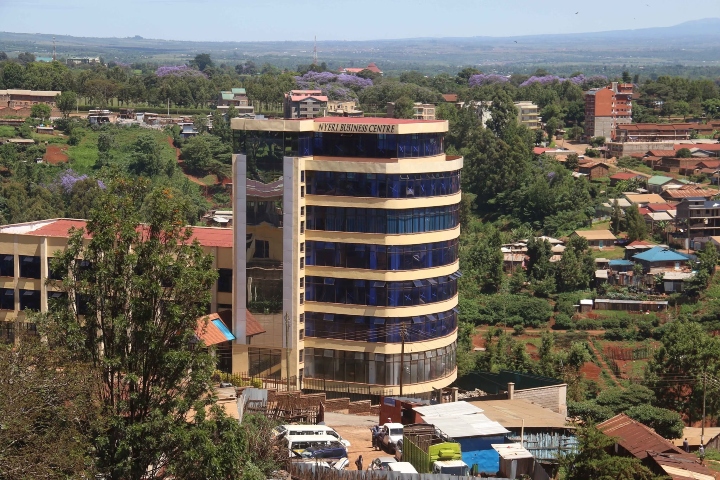
Karen Auto Mart’s attempt to stop the auction collapsed after the company failed to honour a KSh 165 million settlement agreement. However, the court ordered fresh valuation of the Nyeri property and disclosure of detailed loan statements before any sale.
The High Court has lifted an injunction blocking Co-operative Bank from pursuing the sale of Nyeri Business Centre.
The ruling followed a dispute over loans exceeding KSh 221 million and allegations of excessive interest.
Justice Kizito Magare dismissed an application by Karen Auto Mart Limited and Auto Drive Limited.
The companies had sought to stop the bank from selling the commercial property. They also challenged its debt calculations, interest rates and valuation of the building.
But a written settlement agreement proved decisive against their application.
The judge found that Karen Auto Mart had acknowledged owing the bank KSh 212.89 million.
It subsequently failed to honour an agreement to settle the debt for KSh 165 million.
The court, however, imposed fresh conditions before the bank can proceed with any sale.
These include obtaining an updated valuation and supplying detailed statements for the disputed loan accounts.
The Debt Admission
The dispute centred on L.R. Nyeri Municipality Block 11/361, which houses Nyeri Business Centre.
Auto Drive Limited owns the property and charged it to secure Karen Auto Mart’s borrowing.
The bank’s facilities to the businesses date back several years. They included construction financing, overdrafts and working-capital facilities.
In May 2024, the bank proposed consolidating the outstanding facilities into two loans. These comprised a KSh 116.8 million MSME term loan and a KSh 50.28 million mortgage.
The consolidated figure stood at approximately KSh 167.1 million, attracting annual interest of 20.5 per cent.
The borrowers disputed the subsequent balance, arguing that they had already repaid KSh 180.66 million.
They questioned how the bank could still demand more than KSh 221 million.
However, the judge focused on a settlement agreement signed on July 4, 2025. Under that agreement, Karen Auto Mart acknowledged an outstanding indebtedness of KSh 212,894,635.50.
The bank agreed to accept KSh 165 million in full settlement. The borrower was required to deposit KSh 16.5 million within seven days. It would then pay the balance within 60 days.
No payment was made.
The agreement allowed the bank to revert to recovering the full outstanding debt.
Justice Magare held that the borrowers had not established grounds for setting aside the consent.
Such grounds could include fraud, misrepresentation, coercion or undue influence. None had been properly pleaded or demonstrated.
The judge also faulted the borrowers for failing to disclose the agreement. He stressed that parties seeking equitable relief must disclose material facts fully.
Interest Dispute
The borrowers also accused the bank of retaining excessive interest despite reductions in the Central Bank Rate.
They cited ten rate reductions between August 2024 and February 2026.
According to their application, the benchmark rate fell from 13 per cent to 8.75 per cent. They argued that the bank should have passed those reductions to them.
They relied on sections 44 and 16A of the Banking Act. However, the judge found their argument insufficient to justify stopping the proposed sale.
The borrowers had not identified a contractual provision requiring automatic adjustments. The bank relied on clauses granting discretion over its base rate and interest calculations.
Justice Magare observed that section 44 principally regulates increases in banking rates and charges. It did not establish the borrowers’ claim that the bank unlawfully failed to reduce interest.
The court left the broader contractual dispute for determination during the trial. It also noted that any established overcharge could be credited or refunded.
Valuation Concerns
The property’s valuation emerged as another major point of disagreement. A September 2021 valuation placed its open-market value at KSh 250 million.
A subsequent report by FAPCL Valuers, dated April 17, 2025, valued it at KSh 200 million. That report placed its forced-sale value at KSh 150 million.
The borrowers later obtained a March 2026 valuation placing its open-market value at KSh 350 million.
They argued that improvements, including a passenger lift, had increased its worth.
But the judge found that competing valuations alone did not establish professional misconduct.
He also noted that the borrowers’ latest valuation did not provide a forced-sale figure.
Importantly, the court declined to order a joint valuation. It held that the statutory responsibility to obtain a proper valuation rests with the chargee.
Nevertheless, the bank cannot rely on its April 2025 valuation indefinitely. The court ordered it to obtain a fresh valuation before taking further steps towards selling the property.
The bank must also serve that valuation on the borrowers’ advocates. This must happen at least 14 days before any proposed sale.
Statements Ordered
The borrowers had also sought certified and reconciled statements covering ten loan facilities. They wanted the documents to establish the precise outstanding balance.
The judge declined to order a comprehensive reconciliation at this stage.
He found that doing so would prematurely determine issues reserved for trial.
However, he directed the bank to provide detailed statements within 30 days. The statements must cover each facility from January 1, 2024, or its opening date.
They must show all debits, credits, interest rates and charges. The order gives the borrowers further information to assess the debt and their redemption obligations.
Justice Magare also rejected the argument that selling the property would cause irreparable harm.
READ ALSO: High Court Clears Bank of Baroda to Auction Parklands Home in KSh25.9 Million Loan Dispute
He found that its value and rental income could be quantified financially.
The court further noted that the Land Act provides remedies for unauthorised or irregular sales. That protection weakened the borrowers’ argument for an injunction.
The application was dismissed, and the interim orders were discharged. Costs were left to the cause, with the matter scheduled for pre-trial directions.
The ruling does not finally determine the amount owed or resolve every dispute over interest.
It lifts the immediate restraint while requiring the bank to satisfy fresh valuation and disclosure obligations.
PAY ATTENTION: Reach us at info@gotta.news.