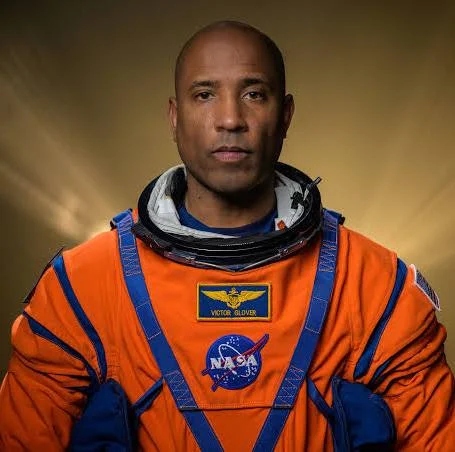
In the grainy intimacy of a viral TikTok clip, Victor Glover is not just an astronaut on the cusp of history – he is, unmistakably, a father.
His voice, steady yet luminous with emotion, carries a pride that transcends rockets and the vacuum of space. It is the quiet, immovable pride of a man who knows his daughters are watching.
“I hope they see what’s possible… not just in space, but in life,” he says softly.
That line – simple, unadorned – has rippled across X, YouTube and beyond, reframing the Artemis II mission as more than a technical feat. It is a human story, anchored in family.
A father watching from earth
As the engines thundered to life, another voice – older, steadier – carried its own weight of history. Victor Glover Sr watched his son rise toward the heavens with a pride sharpened by time.
“To see your son ride a rocket to the Moon… there are no words. I’m proud beyond anything I could have imagined,” he said in televised interviews circulating online.
Then, pausing, he added with quiet gravity:
“He’s not just representing himself. He’s carrying all of us with him.”
In that moment, the launchpad became more than steel and fire—it became a bridge between generations.
It was inspiring to watch the Artemis II launch yesterday — @NASA’s first crewed mission around the moon since 1972. Our space program has always captured an essential part of what it means to reach beyond what we thought was possible, and I hope the four brave astronauts on this… pic.twitter.com/fgNtlRRECV
— Barack Obama (@BarackObama) April 2, 2026
Timeline of a historic journey
The mission itself unfolds with near-poetic precision:
- April 2026 (Launch): Orion lifts off, tearing through Earth’s atmosphere in a blaze of controlled fury.
- Day 2–3: The crew performs systems checks, their capsule shrinking Earth into a fragile blue marble.
Liftoff.
The Artemis II mission launched from @NASAKennedy at 6:35pm ET (2235 UTC), propelling four astronauts on a journey around the Moon.
Artemis II will pave the way for future Moon landings, as well as the next giant leap — astronauts on Mars. pic.twitter.com/ENQA4RTqAc
— NASA (@NASA) April 1, 2026
- Day 4–7 (lunar flyby): They arc around the Moon, travelling roughly 685,000 miles—humanity stretching its reach once more.
- Day 10 (Return): Re-entry ignites the sky; parachutes bloom; the ocean receives them home.
It is NASA’s first crewed deep-space mission in over 50 years; yet its purpose is forward-looking: testing life support, navigation, and endurance for future lunar landings.
@cnn Victor Glover Sr., whose son is an astronaut on the Artemis II moon mission, tells CNN’s Victor Blackwell about the emotional experience of seeing his son go to space. #cnn #artemis ♬ original sound – CNN
The man inside the suit
Away from mission briefings, Glover’s voice softens. Social media reveals something more intimate, more enduring.
“This is for them – my girls. Everything I do, I want them to see there are no limits,” he says.
He is a man of paradox: a naval aviator, a spacefarer, yet deeply tethered to Earth by love.
Even in orbit, he carries history with him, often reflecting on Whitey on the Moon – a reminder that progress must include perspective.
NEW: Artemis 2 crew explains the difficulty of sleeping during their mission to the Moon.
Question: “What does sleeping even look like?”
Answer: “It’s actually sorta comical. Christina has been sleeping heads down in the middle of the vehicle, kinda like a bat suspended from… pic.twitter.com/2wBCtzyh6X
— Collin Rugg (@CollinRugg) April 3, 2026
“That song reminds me… we have to bring everyone along,” he reflects.
A different kind of giant leap
When Artemis II roared skyward, it split the air with the familiar violence of human ambition.
Flames clawed downward; the sky seemed to recoil. And yet, beyond the spectacle, something quieter endured.
A father watching a son. What’s more, a son speaking to his daughters. A world, briefly united, looking up.
READ ALSO: How to Get an A in Physics – A 15-Step Guide
Glover’s journey is measured not just in miles but in meaning – in the widening of what children believe is possible.
And as the rocket disappeared into the vast, unblinking dark, one truth lingered:
This was not just a mission to the Moon. It was a voyage of legacy.
PAY ATTENTION: Reach us at info@gotta.news.