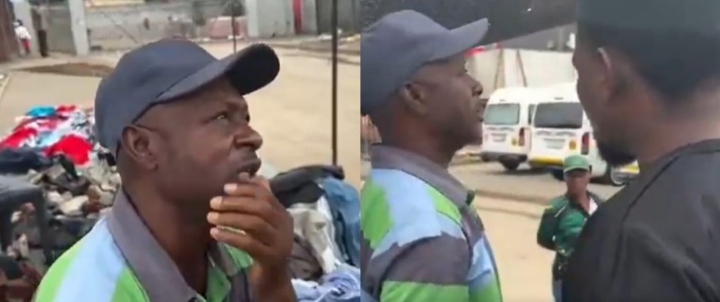
In a tense and unsettling encounter captured on an undated video and widely shared on social media, a Nigerian man operating a modest street-side business in South Africa found himself surrounded by a group of South African men.
A group of South African men abruptly transformed his ordinary day into a moment of public scrutiny and intimidation.
The footage, shared via X (formerly Twitter), opens with the man standing behind what appears to be a small trading setup – humble, functional, and unremarkable.
Encircled and accused
Yet the atmosphere around him is anything but calm. A cluster of men closes in, their voices rising in overlapping accusations and probing questions.
The tone oscillates between suspicion and hostility; their body language tightens the space around them like a vice.
What unfolds is less a conversation and more an interrogation. The Nigerian man, visibly composed but guarded, attempts to respond – his words measured, his posture restrained.
He appears to explain his presence, his work, and his right to earn a living. But his explanations are repeatedly cut short, drowned in a chorus that seems less interested in answers than in asserting dominance.
Take your wife and children back to Nigeria; you are not bringing any skills to South Africa but rather taking up space for unemployed South Africans to work. pic.twitter.com/j2PTpkrc1I
— Judaeda Blanco (@Judaeda3) March 28, 2026
A personal plea, ignored
The camera, unblinking, almost intrusive, captures the imbalance of power. One man gestures sharply; another leans in, his tone accusatory.
At one point, the Nigerian man explains that he is married to a South African woman and has two children with her—an appeal not just to legality but also to shared humanity and belonging.
Yet even this deeply personal revelation does little to soften the mood.
“Go back to Nigeria and fix your country. We South Africans are fixing our country,” one of the men declares, his words cutting through the tension with finality.
In the end, the group demands that the Nigerian man shut down his small business and return to Nigeria.
A wider, troubling pattern
This is not an isolated moment. Across social media platforms and in periodic reports from mainstream outlets, similar confrontations have surfaced – often involving foreign nationals accused, fairly or otherwise, of taking jobs or operating businesses in local communities.
READ ALSO: WATCH: Nigerian Woman Strongly Condemns Attack on Africans in South Africa
And so, in a single street-side scene, a broader story unfolds – of livelihoods under pressure, of borders drawn not on maps but in everyday interactions, and of a continent still grappling with the fragile balance between solidarity and survival.
PAY ATTENTION: Reach us at info@gotta.news.