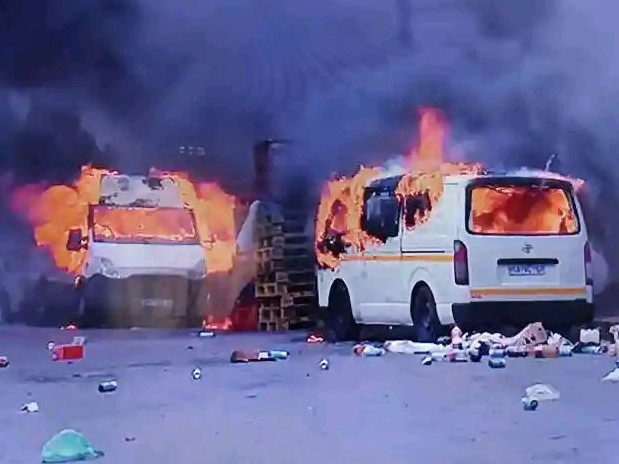
Editorial: South Africa finds itself at a troubling crossroads, where the promise of African solidarity is increasingly engulfed by flames of suspicion and violence.
From KuGompo to previous outbreaks, assaults on fellow Africans reveal a nation grappling with profound inequality, issues of identity, and a pervasive sense of anger.
However, by directing its frustrations outward, it risks undermining the very brotherhood that once supported its own liberation struggle.
From KuGompo to previous outbreaks, assaults on fellow Africans reveal a nation grappling with profound inequality, issues of identity, and a pervasive sense of anger. However, by directing its frustrations outward, it risks undermining the very brotherhood that once supported its own liberation struggle.
The images from South Africa’s KuGompo area are hauntingly familiar. Flames claw at the night sky.
Shops – many modest, some built over years of patient toil – collapse into embers. Men run, not in protest but in pursuit.
Others run simply to survive. In the morning, the same script: charred walls, hollowed streets, and the stunned silence of a community trying to comprehend what it has done to itself.
This time, the spark was a coronation: an Igbo man, Nigerian by origin, installed as a local king. But to focus only on the coronation is to mistake the match for the fire.
Because KuGompo is not an anomaly. It is a continuation.
A pattern written in fire
South Africa has been here before – again and again.
In 2008, xenophobic violence left at least 62 people dead and thousands displaced. Also, in 2015, attacks spread from Durban to Johannesburg, killing several and forcing migrants into hiding.
In 2019, mobs looted foreign-owned shops, leaving at least a dozen dead and reigniting diplomatic tensions across Africa.
Each episode follows a chillingly similar arc: a grievance, real or perceived, erupts into targeted violence against foreign Africans.
Shops are looted. Homes are burnt. Lives are shattered. And then, almost ritualistically, condemnation follows.
Yet the cycle persists.
What unfolded in KuGompo, where protests over a controversial coronation spiralled into attacks on properties linked to foreigners, fits seamlessly into this grim timeline.
The uncomfortable truth about anger
To condemn the violence is necessary. But to stop there is intellectually dishonest.
Because beneath the brutality lies something more complex and more troubling.
South Africa remains one of the most unequal societies in the world. In townships and informal settlements, unemployment is not an abstraction; it is a daily reality.
Opportunity feels scarce. The state often appears distant. And in that vacuum, frustration festers.
Research has long pointed to “relative deprivation” – a potent mix of poverty and perceived injustice – as a key driver of xenophobic violence.
Foreign Africans – Zimbabweans, Somalis, Ethiopians, Nigerians – often become visible symbols of this tension.
They run small businesses. Also, they occupy economic niches. They survive, sometimes even thrive, in environments where many locals feel locked out.
And so, a dangerous narrative takes root: that foreigners are not fellow strugglers, but competitors. That they are not neighbours, but intruders.
It is a narrative that is false – but powerful.
The fatal misdiagnosis
South African authorities have often described these outbreaks as mere “criminality”. Looting, they argue, is opportunistic.
But this framing misses the deeper pathology.
Xenophobia in South Africa is not incidental – it is structural. Surveys have shown deep-seated hostility toward immigrants, with significant portions of the population favouring strict limits or outright bans.
This hostility is rooted in history. Apartheid engineered a society obsessed with belonging and exclusion.
Citizenship, identity, and access were rigidly policed. Decades later, those psychological and structural legacies have not fully dissipated.
Instead, they have been repurposed.
Today, the “other” is no longer defined by race alone but by nationality.
KuGompo: A symbol of a larger crisis.
The coronation in KuGompo struck at something deeply symbolic: authority and identity.
Who has the right to lead? Who belongs deeply enough to rule? And who decides?
For some residents, the installation of a Nigerian-born king may have felt like a rupture – a crossing of cultural and political boundaries.
But the response – violence, arson, collective punishment – reveals a deeper insecurity.
It is not just about leadership. It is about ownership of space, of identity, of economic survival.
And in that sense, KuGompo is not about one man being crowned.
It is about a society grappling – often violently – with the meaning of belonging in a globalised Africa.
The moral failure
Yet even as we acknowledge the grievances, we must confront the moral failure.
The tragic irony of Africans turning against one another is deeply concerning.
South Africa’s liberation struggle was not fought in isolation. It was sustained, in part, by solidarity from across the continent – Nigeria included.
To now see Nigerians and other Africans hunted, their livelihoods destroyed, is not just political failure. It is historical amnesia.
READ ALSO: Chaos in South Africa: KuGompo Erupts After Nigerian Igbo Man Crowned King
Worse still, the violence often targets the most vulnerable: small traders, informal workers, those with the least protection and the least voice.
This is not resistance. It is scapegoating.
A state caught between words and action
The government’s response has followed a familiar script: condemnation, deployment of security forces, and promises of investigation.
But the recurrence of these attacks suggests something more systemic: a failure not just of policing but of policy.
Law enforcement has at times been accused of indifference, even complicity, in abuses against migrants.
Efforts to address root causes – unemployment, inequality, and social cohesion – have been uneven at best.
And so, each new outbreak is treated as an isolated incident, rather than part of a broader crisis requiring sustained intervention.
Breaking the cycle
If KuGompo is to mean anything beyond its own devastation, it must serve as a turning point.
This requires more than arrests. It requires honesty.
Also, it requires acknowledging that xenophobia is not a fringe phenomenon but a recurring feature of South Africa’s social landscape.
It requires confronting the economic despair that fuels it without legitimising the violence it produces.
And it requires reclaiming a principle that once defined the continent’s political imagination: solidarity.
Because the alternative is already visible in KuGompo’s ashes, in its emptied shops, and in its wary silence.
A country that turns its anger inward, against those who look like it, speak like it, and share its history, risks consuming itself.
A final reckoning
The flames in KuGompo will eventually die down. The debris will be cleared. Life, in some form, will resume.
But unless the deeper questions are addressed, the next spark is already waiting.
And when it comes, it will not matter whether the trigger is a coronation, a rumour, or a grievance.
The outcome will be the same. Fire.
PAY ATTENTION: Reach us at info@gotta.news.