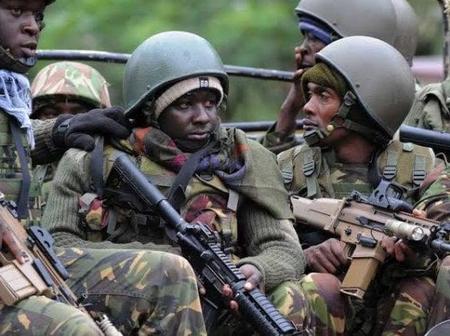
The KDF – a trio of the Kenya Army, Kenya Air Force, and Kenya Navy – embodies the Republic’s commitment to defend its land, its skies, and its seas.
Each branch bears different uniforms and tactics, but all subscribe to the same rock-solid internal architecture of hierarchy that defines where authority begins and ends.
The two-tiered ladder: officers and service members
At a glance, the rank system appears purely orderly. But look deeper, and you discover a brutally meritocratic world where authority is earned, not inherited.
Commissioned Officers – the architects of strategy
At the apex are the commissioned officers (COs) – leaders endowed not just with rank but with strategic command. Their authority stems from a commission given by the Commander-in-Chief – the President of Kenya – the only figure above them in the military hierarchy.
The climb begins with Second Lieutenant, a fresh graduate from the Kenya Military Academy entrusted with a platoon’s lives.
For the newly commissioned, the leap from cadet to lieutenant is a baptism of fire – responsibility for 30 soldiers, tactical orders, and the first taste of real command.
From here the ladder ascends:
– Second Lieutenant
– Lieutenant
– Captain
– Major
– Lieutenant Colonel
– Colonel
– Brigadier (one-star general)
– Major General (2-star general)
– Lieutenant General (3-star general)
– General – the revered four-star rank reserved for the Chief of Defence Forces (CDF).
There is only one four-star general at any given moment – a single pinnacle in an otherwise broad institution. That officer serves not for life but as the strategic spearhead of a nation’s defence.
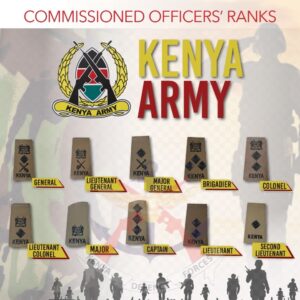
Photo: MoD
Service Members – the backbone of real power
The cadre of service members, which includes non-commissioned officers (NCOs) and enlisted personnel, exists beneath the ranks of commissioned officers.
These are the soldiers who carry out orders, sweat through long field exercises, and command squads in battle.
Promotion here is not simply a patch sewn onto cloth.
It signifies battlefield expertise, leadership skills, and progression through demanding training programmes and career development courses.
The progression unfolds like this:
– Private – the entry point after boot camp.
– Lance Corporal
– Corporal
– Sergeant
– Senior Sergeant
– Warrant Officer Class II
– Warrant Officer Class I – the master sergeants, the spiritual elders in the enlisted ranks.
For many, the ultimate transition comes through a remarkable pathway: senior sergeants with notable service records and specialised skills can, under strict conditions, apply to become Special Duty Officers – commissioned officers rising from the ranks themselves.
A good example of this is the renowned athlete Major (rtd) Paul Tergat, who rose from NCO to CO.
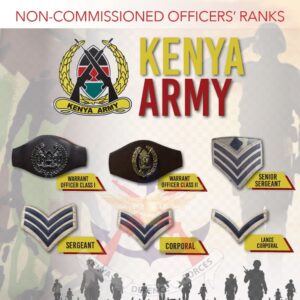
Photo: MoD
Promotion: more than a title
Promotion in the KDF is not automatic. This is where the official doctrine meets the pulse of reality.
Unlike civilian hierarchies where seniority can be the primary arbiter, the KDF demands performance, discipline, examinations, and professional military education as prerequisites for advancement.
For an officer to move from Captain to Major, the individual must not only survive their current command but excel: outstanding evaluations, successful leadership in exercise and conflict scenarios, and often attendance at Command and Staff Colleges or the National Defence University.
For service members, progression hinges on time in service, time in grade, discipline records, and completion of trade and leadership courses.
It is a system that rewards demonstrated excellence over mere longevity.
Tradition and unwritten rules: The “Tonje Rules”
For officers at the very top, tradition adds another layer of complexity – the “Tonje Rules”, named after former Chief of General Staff General Daudi Tonje.
The Tonje Rules, although unofficial, play a significant role in determining tenure at the highest levels, especially for the Chief of Defence Forces and Service Commanders.
Service commanders are expected to serve a maximum of four years or retire upon reaching the age limit for their rank, whichever comes earlier.
This ensures that senior leaders do not ossify into institutions themselves and that institutional rotation and professionalism trump personal longevity.
What’s more, the Tonje Rules have seen leadership rotate more predictably among the services: Army, Air Force, and Navy. However, rotation is encouraged, not guaranteed.
The President retains absolute discretion.
Professionalism, competence, and command experience—typically at a brigade or an equivalent level—are of paramount importance.
Ceremony and symbolism: investiture of ranks
Rank isn’t just a notch on a uniform – it is a lived moment. Every promotion is marked by an investiture ceremony, where newly elevated officers are adorned with their insignia amidst applause and the stern gaze of their commanders.
At these ceremonies, commanders remind officers that the ranks they now wear bring not just authority but the burden of stewardship over those below them.
Rank in action: from battalion to strategy room
KDF Ranks are also practical. A Captain might command a company of 80–120 soldiers, shaping troop movements and tactical execution.
A Lieutenant Colonel oversees a battalion – hundreds in number – balancing logistics, welfare, and combat readiness.
A Brigadier commands a brigade, hundreds of operations wide.
Major Generals command divisions and strategic campaigns.
READ ALSO: KDF ranks and salaries: All you need to know
At the pinnacle, the General, the Chief of Defence Forces, commands with influence that reverberates from statehouse councils to foreign theatres of peacekeeping and war.
PAY ATTENTION: Reach us at info@gotta.news.