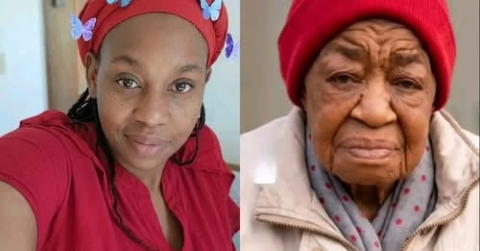
At 31, Snenhlanhla Khoza should have been moving through the ordinary rhythms of young adulthood: raising children, arguing about bills, laughing with friends, and planning tomorrow.
Instead, she has become the face of a medical mystery so brutal it appears to be dragging her body through time at terrifying speed.
The South African mother from Mtubatuba, KwaZulu-Natal, has stunned social media after images and videos of her dramatic physical deterioration spread across Facebook, TikTok and X.
In just about four years, according to reports and interviews circulating online, Khoza’s face, skin and body changed so rapidly that many who saw her could barely believe she was only 31.
And then came the whispers.
In townships and comment sections alike, superstition arrived before science. Some blamed curses.
Others muttered about witchcraft or spiritual punishment.
The internet, that vast courtroom of instant judgement, did what it often does to suffering it cannot explain: it sensationalised it.
But behind the viral fascination lies something colder, rarer and far more devastating.
Werner syndrome
Medical observers believe Khoza may be suffering from Werner syndrome, an extremely rare genetic disorder sometimes called “adult-onset progeria”, a disease that accelerates the body’s ageing process with frightening intensity.
Unlike childhood progeria, which strikes early, Werner syndrome often emerges in a person’s twenties, when the machinery of youth is expected to be at its strongest.
Then suddenly, it begins to collapse.
Hair greys or disappears. Skin tightens and wrinkles. Bones weaken. Cataracts cloud vision.
Muscles waste away. The body starts behaving not like that of a 31-year-old but someone decades older.
Scientists link the condition to mutations affecting DNA repair, as if the body loses its ability to properly maintain itself, cell by cell.
That is the cruelty of diseases like this: they do not merely attack health. They steal time itself.
And the images emerging from Khoza’s story carry that heartbreak with cinematic force.
In some clips, she appears exhausted, fragile, almost folded inward by the weight of an invisible enemy.
Ageing Storm
The contrast is jarring: a young woman’s chronological age trapped inside a body ravaged by premature decline.
The effect unsettles people because it violates something primal, our expectation that ageing should arrive slowly, politely, one wrinkle at a time.
Instead, for Khoza, it seems to have arrived like a storm.
South African media reports say she developed normally through childhood and much of adulthood before her condition sharply worsened around when she was 27 years old.
Experts say Werner syndrome is genetic, not contagious, not supernatural and not evidence of some hidden curse.
There is currently no cure. Treatment usually focuses on managing complications: diabetes, cardiovascular disease, osteoporosis, failing eyesight and heightened cancer risk.
Which leaves patients fighting not one battle, but many: against pain, against isolation, against poverty, against misunderstanding and, perhaps most painfully, against the mirror itself.
READ ALSO: Here’s list of 10 deadliest cancers
For now, Khoza remains suspended between viral attention and medical uncertainty, her face recognised by millions who may never fully grasp what she is enduring.
PAY ATTENTION: Reach us at info@gotta.news