Blogs & Opinion
Joe Kadhi: The Editor Who Defied State House to Tell Kenya the Truth on Saba Saba

On the morning of July 7, 1990, Nairobi braced for impact.
The streets carried the uneasy silence that often precedes history. Riot police stood ready. The feared General Service Unit (GSU) had been deployed.
Opposition leaders had been arrested. Yet thousands of Kenyans still streamed towards Kamukunji Grounds, determined to demand the restoration of multiparty democracy.
Inside the Daily Nation newsroom, another battle was unfolding.
It would not be fought with tear gas, batons or bullets.
It would be fought over ink.
While names such as Kenneth Matiba, Charles Rubia, James Orengo, Raila Odinga and Martin Shikuku rightly occupy a celebrated place in Kenya’s second liberation, another man quietly risked everything to ensure the country, and the world, would know exactly what happened that day.
Disappeared Into Toilets
That man was the late Joe Kadhi.
As Managing Editor of the Daily Nation, Kadhi found himself confronting a dilemma that has haunted editors in authoritarian societies for generations: obey power and survive, or publish the truth and pay the price.
He chose the latter.
The tension inside the newsroom was almost physical.
Journalists knew that whoever ventured into Nairobi’s streets would likely encounter flying stones, gunfire, truncheons and clouds of choking tear gas.
According to accounts Kadhi often shared with his journalism students and in MCK trainings years later, many of the male reporters quietly disappeared into the newsroom toilets, hoping not to be assigned to cover what everyone expected would become a violent confrontation.

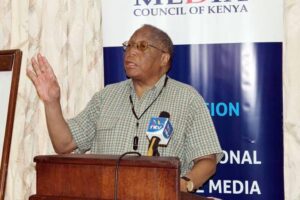
Joe Kadhi at a past MCK conference. Photo/courtesy
Then one young reporter shattered the paralysis. Catherine Gicheru calmly volunteered.
If no one else would go, she would.
Her courage broke the spell. Other reporters and photographers followed.
Hours later they returned looking exactly as one would expect after walking through a battlefield.
Their clothes were stained with blood.
Their faces carried exhaustion. But in their hands lay journalism’s greatest prize.
The story.
Kadhi immediately recognised its significance.
Rather than rush the newsroom or dilute the reporting, he gave his journalists the space to piece together every eyewitness account, every photograph and every detail.
More Than A Protest
He understood they were documenting far more than a protest.
They were recording a turning point in Kenyan history.
Yet the greatest test was still ahead.
As printing time approached, the telephone began ringing.
On the other end were influential editors and establishment figures, urging restraint.
Some argued the story should be dropped altogether. Others warned of the consequences of challenging the state narrative.
Among those Kadhi later recalled contacting him were prominent newspaper editors aligned with the political establishment, such as Philip Ochieng from the Kenya Times and a top editor of The Standard at the time, all urging him to reconsider publishing the full account.
The calls kept coming.
Then came State House.
Soon afterwards came another message carrying perhaps even greater weight.
Agha Khan’s Personal Assistant
The personal assistant to the Aga Khan, then proprietor of Nation Media Group, called.
For many editors, that conversation alone would have settled the matter.
Not for Joe Kadhi.
According to his own recollections, Kadhi responded by reading part of his employment contract aloud. One clause stood out.
His duty, he reminded them, was never to miss a major story.
This story was undoubtedly one.
There was another reason he refused to retreat.
How, he later asked, could he tell young reporters who had risked their lives that their sacrifice would never reach the public?

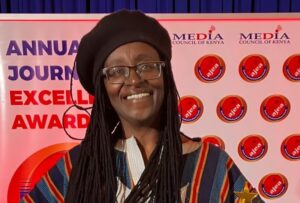
Catherine Gicheru led a team of Nation journalists in covering the Saba Saba events. Photo/courtesy
Publishing, to him, was about more than headlines.
It was about honour.
On the same scale, it was about leadership.
It was about teaching an entire generation of journalists that courage inside the newsroom should match courage in the field.
Extra Edition
That night, the presses rolled.
The Daily Nation carried one of the most comprehensive accounts of the Saba Saba protests, backed by powerful photographs and detailed reporting that captured both the violence and the determination of ordinary Kenyans demanding political change.
Public demand proved overwhelming. Copies disappeared rapidly, forcing the newspaper to produce an extra edition the following day.
The paper had done what newspapers are meant to do.
Bear witness.
The consequences arrived swiftly.
Kadhi would eventually lose his position at the Nation, a professional price many colleagues have linked to the paper’s uncompromising coverage of Saba Saba and its aftermath.
Academia and Death
Yet what looked like defeat became an unexpected second act.
He entered academia, teaching first at the University of Nairobi and later at United States International University Africa, where generations of journalists encountered not merely a lecturer but a living reminder that journalism is a public trust.
Those who studied under him remember his sharp intellect, relentless logic and unwavering insistence that journalism is a profession, not a trade.
His lectures returned repeatedly to Saba Saba.
Not because he wished to celebrate himself.
But because the events of July 7, 1990, illustrated journalism’s highest calling: speaking truth when silence is safer.
Joe Kadhi died on June 29, 2022, leaving behind books, students and a formidable reputation as one of Kenya’s greatest media scholars.
Yet perhaps his finest legacy was neither written in a classroom nor bound between book covers.
It was printed under immense pressure on a tense July night in 1990.
History remembers the politicians who stood on the barricades.
READ ALSO: Joe Kadhi: Revered Journalist and Media Scholar Dies
It should remember, too, the editor who ensured the nation could see them.
While others fought for democracy in the streets, Joe Kadhi fought for it in the newsroom: one headline, one decision and one fearless edition at a time.
Support the journalism you love. Become a Gotta Member.
Every Gotta Membership helps fund fearless reporting, in-depth analysis, and the stories that matter most. Purchase anytime, as often as you wish, and help keep independent journalism thriving.
Join Gotta Membership today. Click HERE to check out securely with Paystack.