Blogs & Opinion
Mary Claire Achieng’s Story: Gun Threats in Church And WhatsApp Messages That Foretold Horror

Three months have passed since concentrated acid ripped through Mary Claire Ochieng’s face, chest, hands, and thighs, forever altering her life as a 25-year-old Seventh-day Adventist singer.
Yet as she sat before Citizen TV cameras for her first public interview, it quickly became clear that she was not merely recounting an attack.
She was assembling what she believes was a trail of warnings that had gone unheeded for years.
The interview unfolded less like a conventional television conversation and more like the piecing together of a puzzle whose fragments had always been visible but never fully connected.
One message.
One assault.
One threat.
One police report.
Then another.
And another.
Until, she says, the violence culminated in the attack that left her fighting for her life.
According to Claire, she met Elvis Opiyo in 2019 during a church function.
They officially started dating in 2021.
She says she believed she was entering a relationship with a man who presented himself differently from who he really was.
Only later, as she told Citizen TV, did rumours begin circulating that the man she loved was already married.
When she confronted him, he allegedly denied everything.
But suspicion eventually gave way to certainty.
Claire says she discovered he was not only married but also had two children, a revelation that fundamentally changed the relationship.
She says she made the decision in April 2025 to walk away.
For many people, ending a relationship is painful.
For Claire, she alleges, it became dangerous.
Digital Trail of Fear
Perhaps the most haunting moments of the Citizen TV interview were not the photographs of burn scars.
They were the WhatsApp screenshots.
Displayed one after another, the conversations paint a portrait, still untested in court, of a relationship that Claire describes as increasingly controlling.
In one exchange, Claire says she pleaded with Elvis Opiyo to resolve issues with his wife and allow everyone to move on peacefully.
Instead, the response allegedly turned ominous.
“I told you to block her… I will beat and kill this woman… Only death will separate you and me,” reads one of the messages shown during the interview.
The contrast is striking.
Some conversations contain declarations of affection.
Others contain apologies.
Others offer expensive gifts, including an iPhone reportedly worth KSh 185,000, and money amounting to KSh 500,000.
Claire says she rejected every offer.
Repeatedly.
“I don’t want your money,” she says she told him.
The interview suggests the gifts were never simply gifts.
Claire alleges they became another instrument of control.

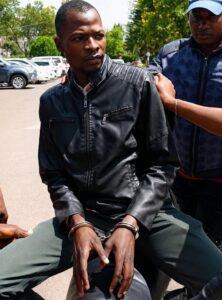
Elvis Opiyo, the main suspect in Mary Claire’s acid attack. Photo/courtesy
She claims Opiyo later demanded she return virtually everything he had ever bought her, including clothes, shoes, and spectacles, and even resign from a job she had secured through his connections.
The message, she says, was unmistakable: if she was leaving the relationship, she had to leave everything associated with it.
The Attacks Before March 17
Perhaps the most disturbing revelation in the interview is Claire’s allegation that the March 17 acid attack was not the first attempt to harm her.
Instead, she describes what she believes was an escalating pattern.
She alleges she was assaulted in public.
Mary Claire says acid had previously been poured on one of her legs.
She recounts being threatened with a firearm inside church.
She also describes two suspicious motorcycle collisions in Katani within days of each other.
Looking back, Claire believes they were rehearsals.
“It seems they had been testing all these before their final one,” she told Citizen TV.
Those allegations remain before investigators and have not been determined by a court.
The Morning Everything Changed
On March 17, while walking home from work along Ngong Road, Claire says two men riding a motorcycle approached her.
Seconds later, concentrated sulphuric acid was allegedly splashed onto her body.
Witnesses rushed to help. Hospitalisation followed.
Months of treatment followed.
The physical injuries are visible.
The emotional ones are harder to photograph.
Police have since arrested suspects, including Elvis Opiyo, who investigators allege was linked to planning the attack.
He has not been convicted, and the criminal case remains before the courts.
A Familiar Story in Kenya
Claire’s interview resonates because it echoes patterns documented in other Kenyan cases involving acid violence and intimate partner abuse.
Survivors have frequently described escalating warning signs before catastrophic violence: stalking, repeated assaults, threats, coercive control and reports made to authorities.
Human rights organisations have long argued that gender-based violence cases often suffer from delayed investigations, inadequate victim protection and poor enforcement of restraining measures.

Those systemic concerns have repeatedly surfaced in public debates following high-profile attacks.
That does not mean every report is ignored. Nor does it mean every investigation fails.
But for many survivors, justice is experienced not only in courtrooms but also in whether institutions intervene before violence reaches its most devastating conclusion.
Claire’s allegations of previous assaults, and reports that some incidents had previously been brought to police attention, will inevitably raise difficult questions about whether earlier intervention could have prevented the alleged attack.
Those questions deserve careful investigation rather than speculation.
One she says she could not fully see while living through it.
The Questions That Remain
As the criminal proceedings continue, the courts, not public opinion, will determine criminal responsibility.
But Claire’s interview has already achieved something significant.
It has shifted attention beyond the horrifying images of burns to the warning signs she says preceded them.
The interview challenges investigators, prosecutors, churches, employers and society itself to ask uncomfortable questions.
When someone repeatedly says they are afraid, who listens?
When threats appear in black-and-white on a phone screen, when does concern become intervention?
READ ALSO: Edwin Muthomi: KDF Captain Accused of Murdering Wife Was Special Forces Commander
And when violence escalates one incident at a time, at what point does prevention become everyone’s responsibility?
For Mary Claire Ochieng’, those questions are no longer theoretical.
They are etched into scars that will endure long after the headlines have disappeared.
Support the journalism you love. Become a Gotta Member.
Every Gotta Membership helps fund fearless reporting, in-depth analysis, and the stories that matter most. Purchase anytime, as often as you wish, and help keep independent journalism thriving.
Join Gotta Membership today. Click HERE to check out securely with Paystack. Reach us at info@gotta.news.